

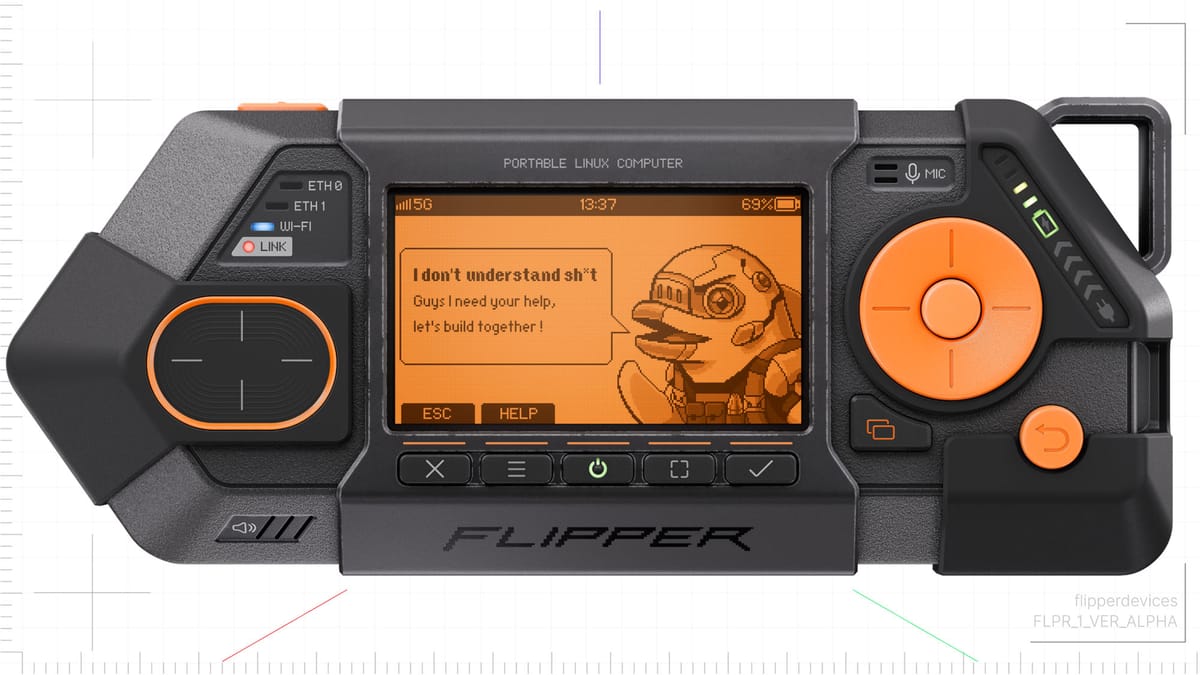
cross-posted from: https://piefed.world/c/tech/p/1140535/flipper-one-we-need-your-help
With Flipper One, we’re reimagining what a Linux cyberdeck can be — it’s a huge project. We’re opening up the development process and asking the community for help.
I’m curious. What is this? What does it do? I was somewhat familiar with the zero that it can transmit signals or something? I only ever saw people use them as TV Remotes
This one is more like a very advanced raspberry pi. It is a powerful computer in your pocket with network jacks, wifi, Bluetooth and HDMI. It can be used for network analysis, penetration testing, software development. What it will actually be used for: plugging into your TV to stream movies.
I got an Nvidia shield and Jellyfin server for that
It is basically an SDR kit that is really easy to use and really well marketed. So script kids can go arround messing with radio controlled things with bad (or no) security.
These are the good guys, when we land in cyberpunk dystopia hell, these will be the guys I’m joining up with.
What do you mean, when…we are there.
I haven’t had my intro sequence where some dramatic event forces me out of my horrible corpo job yet, but I’m expecting it any day now.
I’ve been planning for a while to build a small ARM based cyberdeck style survival PC. It would have a big modular battery, transflective LCD, external wifi, and an SDR. Looks like this thing has many of those features in a tiny little build.
I wish I had the skillset to help with this. The zero was a very cool little toy
I have the skillset. I wish I had the time.
Between this and the Cardputer-zero, im very excited for the next-gen digital swiss army knives.
Credit-Card Size
Oooooh
Product Size 84.0 x 54.0 x 19.7 mm
How thick are your fuckin’ credit cards?!?
The new AmEx cards are getting out of hand.
AmEXXXXXXXXL
Survival desktop!!! This is such a cool project!
I wish their stuff didn’t get as widely marketed as it did. They seem like luxury little hardware toys and exactly like something that can stimulate me back into making more projects. But they are universally known as “those hacking things for thieves”, so even importing one can get me into hot water probably.
Nice step up, so this is the Pi Zero one if the Zero was the Pico one (try saying that three times quickly). Cool
Depends on where, they’re legal in most countries despite their rep. Apparently the UK hates them though. They’re legal in Canada again however.
The dumb thing is, a lot of the videos that went viral about the Zero were fake BS like “watch me steal this car with a flipper zero” or similar.
Sure you can utilize it in pen testing, but you can also utilize a hammer. Doesn’t mean either are designed for illicit purposes.
Can’t even buy it in Canada AFAIK it’ll just get seized at the border.
this is what I call dreaming!
deleted by creator
I love this, read the whole article, but I still feel underwhelmed.
I have a ton of older hardware lying around, all running Linux and perfectly capable to perform the tasks outlined. Incl. a Nokia N900 that can be ssh’d into etc. It’s of similar size AND has a keyboard. Granted, that one does not have an ethernet port but the others do.
And we all know how easy it is to buy an ARM board, install Linux and add all the ethernet ports one desires.
So, apart from the really nice form factor, why this one above all these options?
And we all know how easy it is to buy an ARM board, install Linux and add all the ethernet ports one desires.
We do?
I reckon it’s via an USB-Ethernet adapter.
If you use USB Hubs you could theoretically add as many as you want on a single USB port if you daisy chain the Hubs (if it’s a really large number some of the Hubs must have external power).
Granted, performance is limited.
Never tried it, though, so maybe there are further limitations.
It’s not a form factor, it’s an entire package. Modular hardware, expansion, OS, software ecosystem…etc.
What you’re saying is akin to “I have old laptops, so why would I buy a Framework?”
For it’s functionality.
An RPi doesn’t have any of this by default as an SoC, especially the updated wireless modules. This also allows expansion as needed for cheap modules to be connected, so the benefit of upgrades is possible. Sounds like a big win.
It was a bit like that with the Zero as well. All those tools existed as separate packages, and some were bundled, but the complete feature set and the form factor made it the best wireless signal analysis tool on the market.