
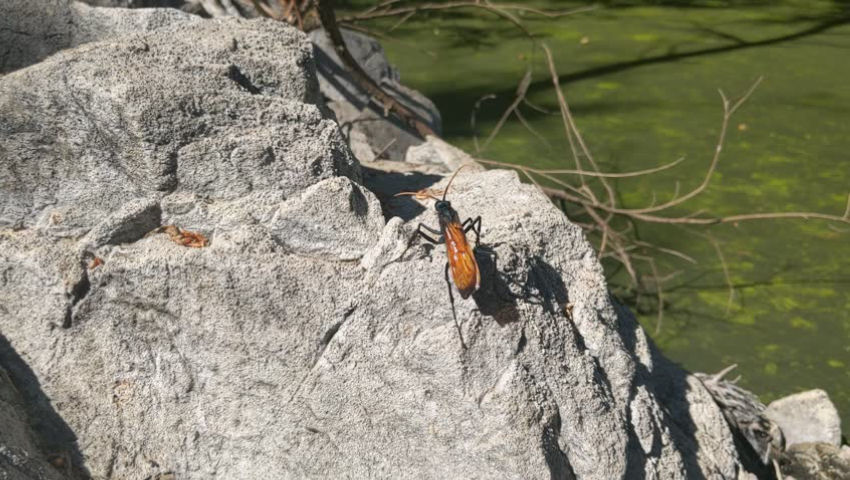
https://en.wikipedia.org/wiki/Tarantula_hawk
Behavior
The female tarantula hawk wasp stings a tarantula between the legs, paralyzing it, and then drags the prey to a specially prepared burrow, where a single egg is laid on the spider’s abdomen, and the burrow entrance is covered… When the wasp larva hatches, it creates a small hole in the spider’s abdomen, then enters and feeds voraciously, avoiding vital organs for as long as possible to keep the spider alive. After several weeks, the larva pupates. Finally, the wasp becomes an adult and emerges from the spider’s abdomen to continue the life cycle.
Sting
Tarantula hawk wasps are relatively docile and rarely sting without provocation, but the sting—particularly that of P. grossa—is among the most painful of all insects, …One researcher described the pain as “…immediate, excruciating, unrelenting pain that simply shuts down one’s ability to do anything, except scream. Mental discipline simply does not work in these situations.” In terms of scale, the wasp’s sting is rated near the top of the Schmidt sting pain index, second only to that of the bullet ant, and is described by Schmidt as “blinding, fierce[, and] shockingly electric”. Because of their extremely large stingers, very few animals are able to eat them; one of the few that can is the roadrunner. Many predatory animals avoid these wasps, and many different insects mimic them, including various other wasps and bees (Müllerian mimics), as well as moths, flies (e.g., mydas flies), and beetles (e.g., Tragidion) (Batesian mimics)…
Because of their extremely large stingers, very few animals are able to eat them; one of the few that can is the roadrunner.
Beep beep