

Drop Site is a reader-funded, independent news outlet. Without your support, we can’t operate. Please consider becoming a paid subscriber or making a 501©(3) tax-deductible donation today.
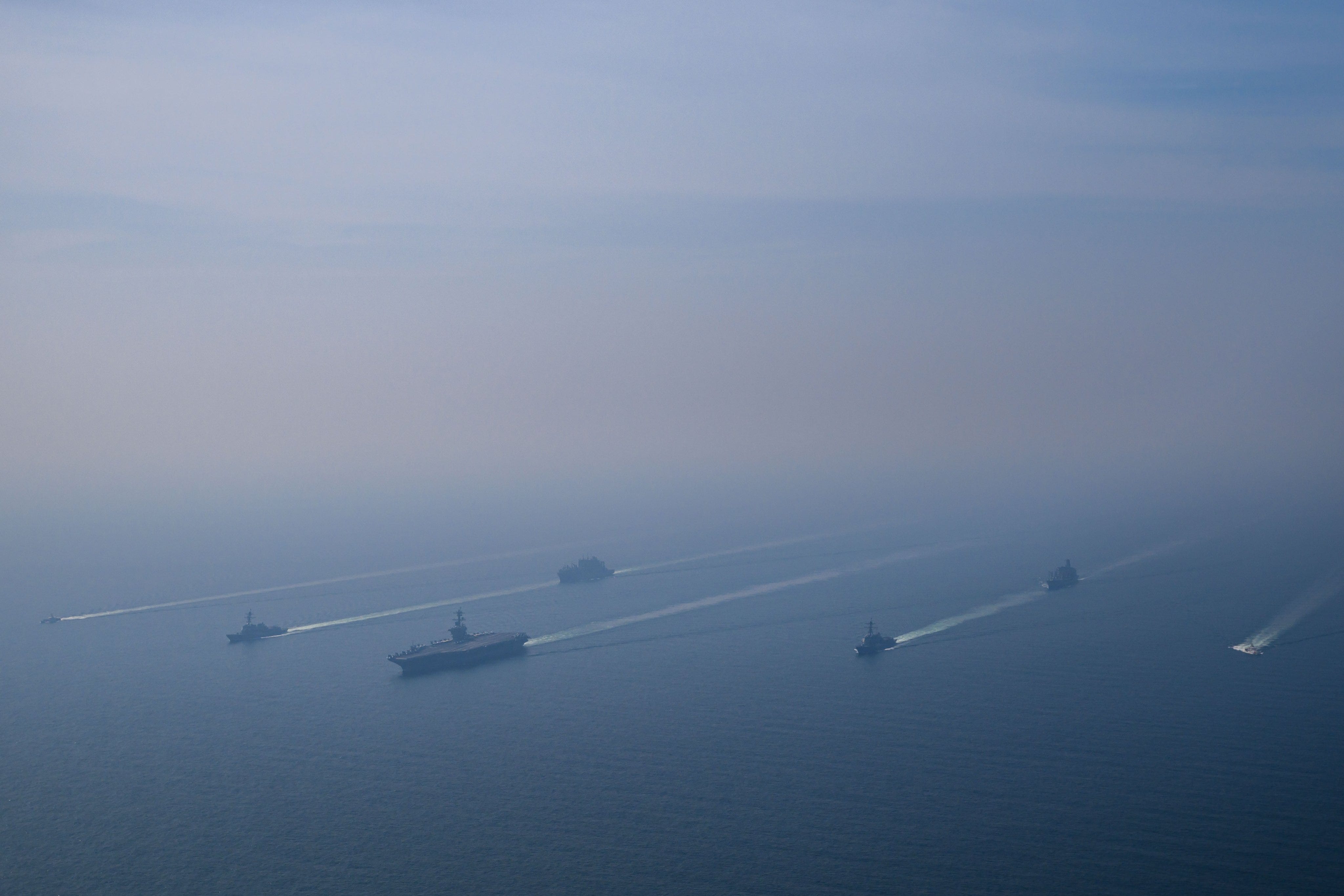
An aerial view of the USS Abraham Lincoln Carrier Strike Group while operating at the Arabian Sea, escorted by two military replenishment ships and two U.S. Coast Guard vessels, as fighter jets from Carrier Air Wing Nine conducted flight operations overhead in the Arabian Sea, on February 6, 2026. (Photo by US CENTCOM/Handout/Anadolu via Getty Images)
The U.S. military is in the midst of amassing an enormous fleet of aircraft and warships within striking distance of Iran as the region enters the Islamic holy month of Ramadan. It is the largest buildup of firepower in the Middle East since President Donald Trump authorized a 12-day bombing campaign against Iran last June that killed more than 1,000 people.
While Iranian and U.S. negotiators are speaking in cautiously optimistic tones about the latest round of indirect talks held Tuesday in Geneva and suggested another meeting was possible, comments from the highest levels of power in both countries drive home the reality that the U.S. may be on the verge of attacking the Islamic Republic.
“In some ways it went well. They agreed to meet afterward,” Vice President JD Vance told Fox News on Tuesday, following the talks. “But in other ways, it was very clear that the president has set some red lines that the Iranians are not yet willing to actually acknowledge and work through.” Vance maintained that Trump prefers a diplomatic solution, but warned that “the president reserves the ability to say when he thinks that diplomacy has reached its natural end.”
A former senior U.S. intelligence official who is an informal advisor to the Trump administration on Middle East policy told Drop Site that, based on his discussions with current officials, he assesses an 80-90% likelihood of U.S. strikes within weeks.
The extraordinary and expensive U.S. military buildup would be sufficient for a large-scale campaign against Tehran that goes far beyond the limited strikes that have taken place in the past. “It harkens back to what I saw ahead of the 2003 Iraq war,” said retired Lt. Col. Daniel Davis, a senior fellow and military expert at Defense Priorities, in an interview with Drop Site News. “You don’t assemble this kind of power to send a message. In my view, this is what you do when you’re preparing to use it. What I see on the diplomatic front is just to try to keep things rolling until it’s time to actually launch the military operation. I think that everybody on both sides knows where this is heading.”
Iran realizes that it is facing an unprecedented threat from the U.S. if a deal that conforms with Trump’s terms is not reached, former Pentagon official Jasmine El-Gamal told Drop Site. “This is not a dress rehearsal,” she said. “This is it. This is not the negotiations of last year or the year before or the year before that. They’re backed into a corner. There’s no off ramp.”
The ongoing deployment includes the stationing of dozens of aircraft including F‑15 strike fighters, F‑35 stealth fighters, Boeing EA‑18G Growler electronic‑warfare aircraft, and A‑10C ground‑attack aircraft at a military airbase in Jordan—despite the Jordanian government’s recent insistence that its territory would not be used as a base to attack Iran. Dozens more F-35, F-22, and F-16 fighter jets have also been observed by independent flight trackers transiting to the region over the past 48 hours, along with a large number of tanker refueling aircraft departing from the continental U.S.
Two carrier strike groups—each built around one aircraft carrier, several guided‑missile destroyers armed with Tomahawk missiles, and at least one submarine—are also being stationed nearby, along with several additional U.S. destroyers and submarines in regional waters near Iran to defend against ballistic missile attacks, as well as more than 30,000 U.S. military personnel and numerous Patriot and THAAD anti-missile batteries spread across regional military bases.
The aircraft carrier USS Abraham Lincoln, which has been in the region since late January, also carries an air wing of roughly 60–70 warplanes, including about 40–45 F‑35C and F/A‑18 strike fighters, as well as Growler electronic‑warfare jets, early‑warning radar aircraft, and MH‑60 attack helicopters.
The USS Gerald R. Ford—which last week was redirected from Venezuela to the Middle East—is the world’s largest and most advanced carrier, and can operate a similar mix of up to 75 aircraft. “The Ford was used for the campaign in Venezuela and eventually the strikes on [President Nicolás] Maduro. And now they’re being sent to the Middle East. They won’t be back for several months. So this is a crew that has been stretched to the limit,” said El-Gamal, who specialized in Middle East policy at the Defense Department. “The fact that that carrier is there tells me that this isn’t just a routine kind of, ‘Hey, let’s flex some muscle.’ He didn’t need that. He didn’t need to send that second carrier to flex muscle.”
President Trump explained the move in remarks at Ft. Bragg as a threat to the Iranians amid ongoing talks, saying, “In case we don’t make a deal, we’ll need it.”
Parallel Negotiations
In June, the Trump administration used the veneer of preparing for additional talks with Iran as cover to launch a surprise attack on the country. Both U.S. and Israeli warplanes struck military and civilian strikes across Iran and killed scores of senior and mid-level Iranian military and intelligence officials, including Mohammad Bagheri, Iran’s highest-ranking military official, Hossein Salami, the commander of the elite Islamic Revolutionary Guard Corps, and Amir Ali Hajizadeh, the IRGC’s chief of aerospace operations who commanded Iran’s ballistic missile strikes. The attacks also killed several Iranian nuclear scientists. Estimates put the number killed in the strikes at more than 1,000, including at least 400 civilians, alongside an additional 4,000 other Iranians—both military and civilian—wounded.
In a speech on Tuesday, Iran’s Supreme Leader Ayatollah Ali Khamenei struck a defiant tone and denounced the Trump administration’s approach to nuclear talks, charging that an ultimatum is not a negotiation. “The Americans say, ‘Let’s negotiate over your nuclear energy, and the result of the negotiation is supposed to be that you do not have this energy,” Khamenei said. “If that’s the case, there is no room for negotiation; but if negotiations are truly to take place, determining the outcome of the negotiations in advance is a wrong and foolish act.”
Acknowledging the “beautiful armada” Trump has boasted of sending to the region, Khamenei said, “The Americans constantly say that they’ve sent a warship toward Iran. Of course, a warship is a dangerous piece of military hardware. However, more dangerous than that warship is the weapon that can send that warship to the bottom of the sea.” He added, “The U.S. President has said that for 47 years, the United States hasn’t been able to eliminate the Islamic Republic. That is a good confession. I say, ‘You, too, will not be able to do this.’”
The Israeli military has also indicated it is making preparations for potential war with Iran. After meeting with Trump in Washington, D.C. last week, Israeli Prime Minister Benjamin Netanyahu put out his own list of priorities, which included ending both Iran’s enrichment program and addressing its ballistic missile capabilities. “[President Trump] is determined to exhaust the possibilities of achieving a deal which he believes can be achieved now because of the circumstances that have been created, the force projection,” Netanyahu said at a conference of presidents of major American Jewish organizations. “And the fact that, as he says, Iran must surely understand that they missed out last time, and he thinks there is a serious probability that they won’t miss out this time. I will not hide from you that I express my skepticism of any deal with Iran.”
El-Gamal, the former country director for Syria and Lebanon at the Office of the Secretary of Defense for Policy under the Obama administration, said she believes Trump would prefer to make a deal that he can claim goes beyond any Iranian concessions made in the 2015 nuclear deal brokered by the Obama administration, specifically dealing with ballistic missiles and support for regional resistance groups. “If he can get that without a military confrontation, he will take it,” she said, quickly adding that Iran almost certainly will continue to hold firm to its red lines against such demands.
“Right now, the ballistic missile program is essentially all Iran has left to maintain any sort of deterrence posture and defend itself and project any sort of power in the region,” she added. “And what is the Islamic Republic of Iran if it doesn’t have the ability—any government, by the way—if it doesn’t have the ability to project power as a serious player in the region, maintain deterrence capacity and defend itself? Then you might as well not be a government at all.”
The former senior U.S. intelligence official told Drop Site that Trump was intent on striking Iran in January, but was not satisfied with the options presented by the military based on the existing assets in the region. The renewed diplomatic talks gave the Pentagon time to dispatch more weapons, ships and planes, significantly expanding the scope and power of potential operations. Extensive deployments are necessary not only to conduct sustained attacks on Iran, but also to position munitions and aircraft for confronting Iranian retaliatory strikes against U.S. military facilities and Israel, which Iran has indicated would come under heavy bombardment in the event of a U.S.-led air war.
While several Arab countries have publicly stated they will not allow their territory or airspace to be used for an assault against Iran, in the event of large strikes, the U.S. would need to utilize command and control and targeting systems in several nations, as well as satellite and surveillance capabilities. Military assets in these countries, including advanced U.S. missile systems, would also be used to confront Iranian retaliatory action.
“Everything was set up” to strike in January, Davis said, “And then all of a sudden it didn’t happen.” Netanyahu was concerned that more defensive capabilities were needed to respond to Iranian retaliation, he said, and these concerns were echoed by Pentagon war planners. “And I think that that delayed it,” Davis added. “And then of course, right after that, you saw this big surge of air defense missiles going in all over the place.”
Following Trump’s inauguration in January 2025, Director of National Intelligence Tulsi Gabbard had asked Davis to join the administration in a senior post where he would have overseen the compiling of the Presidential Daily Briefing, a comprehensive intelligence summary presented each morning to the president. In March, as Davis was going through the background check process, Gabbard withdrew his name from consideration after lawmakers and pro-Israel groups protested, citing Davis’s criticism of Israel, the Gaza War and his opposition to military attacks on Iran. Davis said he maintains contact with what he described as some of the few remaining “sane foreign policy minds” in the administration. “They’re beside themselves because they feel powerless,” he said. “They can only go so far to say something or else they’ll be either removed or sidelined.”
Based on his experience with past U.S. war planning and missions, Davis said he believes the military would first strike Iranian air defense, command and control, communications facilities and senior leaders of the IRGC. It would also target Iran’s offensive missile capabilities, mobile launchers, naval bases and vessels. “We’ll be going after the political leaders simultaneously with a lot of this. They may even go with them concurrently with trying to take out the air defense so that they don’t get a chance to go to bunkers or whatever,” Davis said. “I think that that’s the idea, because if you can take out the senior leaders and decapitate the regime, then you have the chance for people to rise up, at least according to that hoped-for theory.” He added that the U.S. will also likely engage in broader attacks against Iranian security forces that would be used to quell or crush domestic uprisings or riots.
El-Gamal said she believes U.S. war planners are anticipating unprecedented Iranian counterstrikes and will seek to preemptively attack its offensive infrastructure. “You have to stop anything that the Iranians would have planned before they even have the chance to begin. It’s kind of akin to destroying a country’s air force fleet before you go to war,” she said. “If you look at it from that perspective and you look at the assets that are being sent to the region and you look at what the Iranians could be planning as retaliatory attacks on the carrier strike group, attacks on U.S. personnel in the region, and you look at everything that would be needed to do those attacks—the ballistic missiles, the short range missiles, the shaheds, then you will have to have a plan to attack all of it right at the beginning, at the onset. And if you’re going to assume or get ready for talks to fail, that would have to be your plan.”
Drop Site News is reader-supported. Consider becoming a free or paid subscriber.
Trump’s Strategy
In the aftermath of the June strikes, Trump and other senior officials boasted that they had effectively wiped out Iran’s nuclear program. “Our objective was the destruction of Iran’s nuclear enrichment capacity and a stop to the nuclear threat posed by the world’s number one state sponsor of terror,” Trump said in a White House address on June 21. “Iran’s key nuclear enrichment facilities have been completely and totally obliterated.” Defense Secretary Pete Hegseth claimed, “Our bombing campaign obliterated Iran’s ability to create nuclear weapons,” while Secretary of State Marco Rubio said, “This was complete and total obliteration. They are in bad shape. They are way behind today compared to where they were.”
Since those strikes, media reports have suggested Iran is secretly rebuilding and fortifying missile facilities damaged in previous U.S. and Israeli attacks. But satellite images showing the building or reconstruction of access tunnels, which form the basis of these media reports, are not evidence of attempts to build nuclear weapons.
For years, U.S. national intelligence estimates have consistently undermined the alarmist tone of senior U.S. and Israeli officials warning of Iran’s ability to imminently build a nuclear bomb. Those assessments determined that Iran halted its nuclear weapons program in late 2003. For decades, Khamenei has maintained his opposition to producing or using weapons of mass destruction. And Iran has publicly stated that the damage to its missile capabilities by the June war was far less significant than the U.S. claimed and that it has worked to rebuild its conventional missile capacity and stockpiles.
In addition to the U.S. military buildup, the White House has also been engaged in a prolonged economic war targeting Iran that has been described in increasingly blunt terms by Trump administration officials as a tool to generate social unrest inside the country.
At a Senate hearing earlier this month, U.S. Treasury Secretary Scott Bessent described a policy aimed at inflicting maximum economic harm on ordinary Iranians by targeting the strength of the Iranian currency. “What we have done is create a dollar shortage in the country,” Bessent said in response to questioning by Sen. Katie Britt (R-Ala.), stating that the policy had reached a “grand culmination” in December with the collapse of one of the country’s largest banks. “The Iranian currency went into freefall, inflation exploded, and hence, we have seen the Iranian people out on the street,” Bessent said.
The remarks echoed previous statements made by Bessent at the World Economic Forum in Davos in late January in the wake of mass public unrest in Iran. Following large peaceful demonstrations that began in late December against economic conditions in the country, the protests turned violent on January 8, spurring a series of events that would leave thousands of Iranians dead. Bessent described U.S. policy towards Iran at that time as “economic statecraft, no shots fired,” adding that the uprising showed that “things are moving in a very positive way here.”
As riots broke out and spread across the country, Trump called on Iranians to seize state institutions and promised help was on the way to support an insurrection. Police stations, mosques, hospitals, and other sites were attacked as security forces used overwhelming force to crush the rebellion. International human rights organizations have asserted that much of the violence consisted of unprovoked widespread attacks by Iranian security forces on peaceful protesters, while Tehran characterized the events as foreign-organized acts of terrorism.
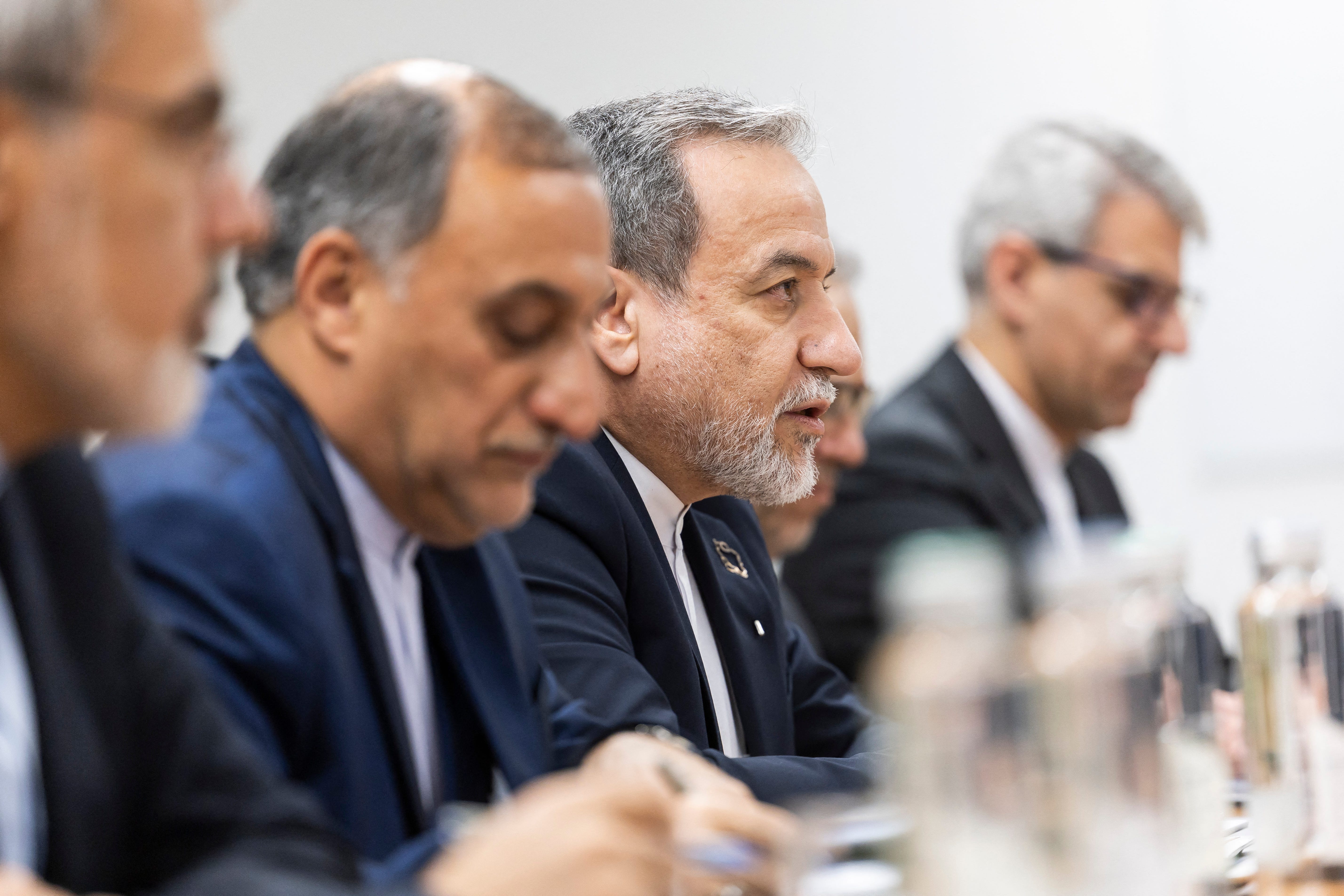
Iran’s Foreign Minister Abbas Araghchi speaks during a bilateral meeting between Switzerland and Iran during a second round of US-Iranian talks with Washington in Geneva on February 17, 2026. (Photo by CYRIL ZINGARO / POOL / AFP via Getty Images)
In advance of the diplomatic talks that began February 6 in Oman, the U.S. and Israel sought to impose an ultimatum on the Iranian side. Not only did they demand a dramatic reduction in Iran’s civilian nuclear capabilities, but also a significant degradation of the country’s ballistic missile capacity—both in terms of stockpile and range—and an end to Iran’s support for armed resistance movements and groups in the region. Iran rejected that framing and insisted it would only negotiate on the nuclear issue.
“The best way I could characterize it is this is a detachment from reality,” Davis said of conversations he has had recently with current U.S. defense officials. He said some of them have spoken of an administration searching for a successful operation like the recent snatching of Maduro in Venezuela or the 2011 overthrow of Moamar Qaddafi in Libya, giving Trump the appearance of a quick regime change victory. “We’ve got a plan A, which is the Libya model—maybe even more than the Venezuela model—that the people will rise up and do on the ground what we don’t have ground troops for,” he said. “Therein is your problem. If plan A doesn’t work, we don’t have a ground force. The chances of having a regime decapitation—even with this massive amount of firepower, and it is massive, no question about that—I think you’re going to be surprised and disappointed. Then what are you going to do next?”
El-Gamal said that suggestions that Reza Pahlavi, the son of the ousted dictator who fled Iran in 1979 as the Islamic revolution began, or the Israeli-linked MEK (Mojahedin-e-Khalq), a fanatical cult-like faction that has achieved success in cozying up to U.S. politicians, would be major players in a regime change operation is fantasy. Iran is not comparable to Syria, she said, where there was a prolonged civil war, involving multiple armed factions and major Western military and intelligence support for overthrowing the Assad government and installing a replacement. More likely, she said, is that U.S. intelligence and military planners believe that if they decapitate the country’s leadership, they could make a deal with the surviving officials, similar to what is unfolding in Venezuela.
“You skim off the minimum required at the top and you keep as much of it as possible in place, but then it becomes a pliant regime. It’s exactly what’s happening in Venezuela,” she said. “If I were sitting at the Pentagon thinking, ‘Okay, how do we do this and not risk a country of 90 million just being a failed state essentially,’ I think that’s what you would try to plan for. So you would look at, what assets are we going to take out? What people and personnel are we going to take out? Who are we going to keep? What intelligence assets, largely Israeli, are we going to activate in order to send the messages that we need to send to the remnants of the regime? And how are we going to turn this around quickly so that you don’t leave a vacuum open?”
The level of military force now or soon to be stationed around Iran would be sufficient for a large-scale military operation potentially lasting weeks or longer. The logistical presence in the region also suggests that the U.S. could facilitate the fueling and support of longer-range heavy aircraft that could launch attacks from U.S. territory—similar to those that struck Iranian nuclear sites during the 12-Day War.
“Over the summer, the U.S. and Israel demonstrated that they can destroy or bypass Iranian air defenses. You probably don’t need eight aircraft carriers in theater, because U.S. aircraft can operate with a high degree of confidence moving in and out of Iranian airspace,” said Harrison Mann, a former U.S. Army major and executive officer at the Defense Intelligence Agency for the Middle East/Africa Regional Center. “If you were trying to implement regime collapse in China or Russia, you would bring far more forces. This is still a budget operation—what is more notable is the reminder of what is not there, which is a substantial number of ground troops. The plan seems to be to simply destroy things until the Iranians accept an escalating list of demands—or until there is simply no government left to accept anything.”
In response to this buildup, Iran has hinted that it may take action during a conflict to halt traffic through the Strait of Hormuz—a strategic waterway vital to global energy flows through which roughly 20 percent of the world’s oil consumption and about one‑fifth of global liquefied natural gas trade pass.
On Monday, Iran’s Islamic Revolutionary Guard Corps Navy started a live‑fire military drill in the strait. Iranian officials framed the exercises as a test of rapid reciprocal response to threats and a signal that they can threaten one of the world’s critical oil and gas chokepoints if pressured further.
“Iran’s missiles wreaked havoc against the best missile defense systems in the world in Israel during the 12-day war. Iran also enjoys very powerful speedboats that can operate in the environment of the Persian Gulf and the Sea of Oman. They can control everything there,” said Mostafa Khoshchesm, security analyst close to the Iranian government. “A second option is shutting down the Strait of Hormuz by mining it, sinking ships, and hitting vessels with missiles from anywhere in Iran.”
In previous cases where Israel and the U.S. have bombed Iran over the past two years, Iran has retaliated with strikes calibrated to avoid killing American military personnel and Israeli civilians and engaged in pre-strike choreography with the U.S. through back channels. The strategy was aimed at Iran being able to respond without dramatically escalating the situation into a larger-scale war. Since early January, Iranian officials have warned they will no longer operate under those informal rules of engagement and intend to inflict real damage in any future strikes. Davis, the retired Army officer, said he believes the U.S. is underestimating Iran’s missile capacity.
“I’ve heard this from people who have access deep inside the Pentagon at the highest levels that there are those who say, ‘I think we can handle Iran’s military, their missile strikes now. I think that we can defend adequately,’” said Davis. “I don’t think we can. I think that Iran demonstrated in the 12 Day War that they could penetrate the absolute best integrated air defense systems that we have. I think it’s a bad gamble—not even a bet, but I think it’s a gamble—to say, ‘I think we can sustain this and still knock them out and get their offensive missiles before they have a chance to shoot us.’”
From Drop Site News via This RSS Feed.
You must log in or register to comment.