


@crowcore_explorer
This study from 2025 might be of interest to you.
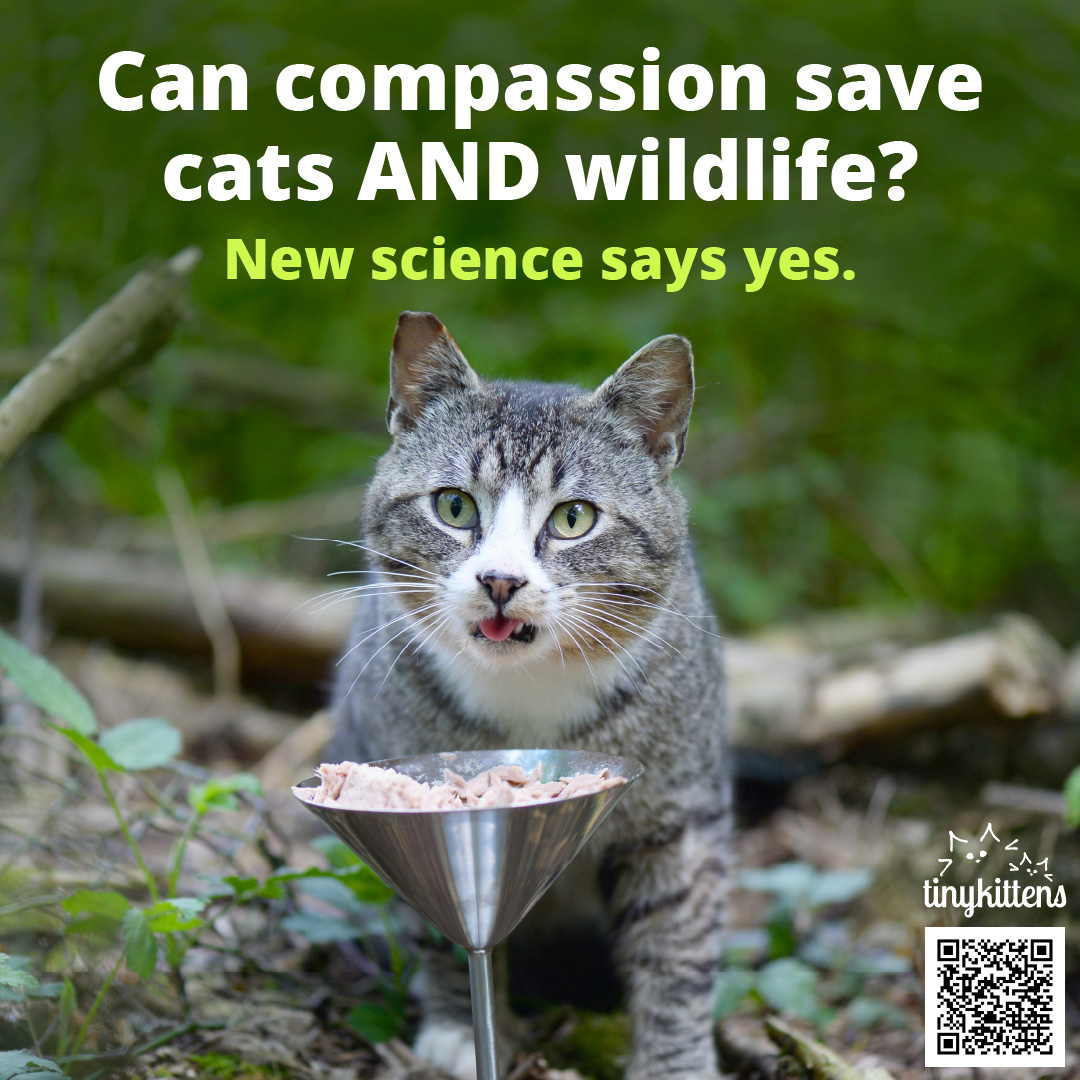
With scientific methods , the Simon Fraser University in Canada, and the feral cat rescue group Tinykittens Society, were able to show that managed cat colonies (providing enough cat food daily and doing TNR) reduce wild prey hunting significantly!
By analyzing chemical markers in cat fur, we compared
cats that lived indoors,
cats before TNR, and
cats after TNR with regular feeding.
Before TNR, cats showed clear signs of consuming wild prey ((mice, birds etc.)), while after TNR and food provisioning their diets shifted to resemble those of indoor cats, relying mostly on commercial food.
“Evaluating the Effects of Managed Free-Roaming Cat Populations on Prey Through Stable Isotope Analysis:
A Pilot Study from British Columbia, Canada” (2025)
full open-access article: https://doi.org/10.3390/ani15213204
Our research provides the first isotopic evidence that Trap-Neuter-Return (TNR) and daily feeding of cat colonies can simultaneously improve cat welfare and reduce ecological impacts on wildlife,
offering a rare win-win model for balancing compassion and conservation.
#TNR #wildlife #cats #feralCats #CatColony #colonyManagement #study #AnimalWelfare
#stableIsotopeAnalysis #freeroamingcats
@crowcore_explorer
Abstract from the study:
Free-roaming domestic cats (Felis catus) present a major management challenge for animal welfare and biodiversity conservation.
Trap-neuter-return (TNR) programs, which include sterilization and return of cats, are increasingly adopted to manage cat populations, often alongside routine food provisioning.
However, their effectiveness in reducing cats’ reliance on wild prey remains contested.
In this study, we use stable isotope analysis (…) of cat fur to investigate dietary patterns before and after TNR implementation (…).
We analyzed samples from 122 cats in a large-scale TNR initiative on a rural property in British Columbia, Canada. These included
Local prey and food sources were also analyzed to provide a comparative isotopic baseline. Our results show clear dietary shifts following TNR.
Group 1 cats exhibited high isotopic variability and elevated δ15N and δ34S values, consistent with wild prey consumption.
In contrast, post-TNR cats showed significantly lower and more homogeneous values, aligning closely with those of indoor, kibble-fed cats.
These changes are consistent with a reduced dietary reliance on wildlife (…) following the combination of TNR with regular provisioning.
These findings demonstrate that regular food provisioning in TNR-managed colonies, particularly when combined with broader environmental changes, can significantly alter cat diets and potentially reduce their dependence on wild prey."
From: Evaluating the Effects of Managed Free-Roaming Cat Populations on Prey Through Stable Isotope Analysis: A Pilot Study from British Columbia, Canada, 2025