

Your friendly neighbourhood sh.it.head
Gamer, book and photography nerd, francophile // Gamer, geek des livres et de la photographie, francophile
- 27 Posts
- 101 Comments

 2·1 month ago
As of now I am currently using FreshRSS, although before I properly deploy this to other users in my family / friends I might give Tiny Tiny RSS (tt-rss) a shot as well. I don’t think the differences will matter for end-users as the majority of mine will likely all be using it through the API via a mobile app (e.g NetNewsWire (ios & mac), FluentReader (desktop), CapyReader (android) etc. etc.)., however the main difference that will dictate which one I stick with is the filtering capabilities and the ease of setup of article-collection with readibility / mercury to remove extrenuous content / ads.
I am also quite interested in miniflux, although it is quite intentionally bare bones. It lacks a plugin api (a potential security improvement), and instead natively supports many of the things people would use plugins for (native youtube-nocookie embedding / invidious embedding, integrations with readlater services like instapaper and wallabag, etc., integrated article fetching and parsing with readibility [and can change user agent / cookies to bypass bot protections]). It also seems to have a bit better security stance (supporting modern web browser features like passkeys, content sanitization, sanitizing url parameters in share links automatically etc.).
Miniflux definitely feels like the best ratio of ootb functionality + security, but the UI of FreshRSS feels more natural if you envisage less techy users to use it (and in my case I see one person using the website over an app).
That is what it seems like based on what I have read :/
I guess the best option in my case then is likely to add them as a non-admin user to my tailnet. The only concern I have is with the potential of one user deactivating the VPN connection unkowingly, which is probably where Funnel comes in as a better option, but I would prefer to avoid serving stuff on the web when possible. (It is specifically a FreshRSS instance for now)
Yes, there is two ways you can go about this. The way that you are thinking of (and the way that I would ideally like to go about this) is as listed on this help article. This is perfect for sharing a home server to some friends, and letting them access a given service without seeing any of your personal devices.
The other option is to have just one tailnet, but having multiple users as detailed here. Notably this can be a security regression (if you don’t limit access on a per-user basis with ACLs), but is ideal for sharing access to your entire network with your spouse / older children within the context of self-hosting.
For example, I have a friend who has shared a minecraft server with me and that is an ideal example of sharing one node to a seperate tailnet. I am an admin of the server, and can manage the docker container for it + the backup sidecar and the SMB share, but that is where my access to his network structure ends.
This contrasts the situation with my partner for example, where we share a tailnet (with seperate user logins) to make things like gamestreaming just that much easier to setup. Hypothetically I can use ACLs to limit access to stuff like the Cockpit web-management portal, or block the SSH port, but I don’t feel like I need to in my specific case.
Addendum: I also think sharing the device out strips it of its subnet routes + services, which is part of the problem I am running into where I do want it to strip subnet routing (my elderly parents DO NOT need access to my printer), but I ideally want to be able to still use tailscale serve + services + https certificates to be able to share my self-hosted RSS feed reader for them (ad-free, no AI slop, much better for my one parental figure with early-onset dementia).
 18·6 months ago
The more important metric to Canonical however is corporate / paying customer marketshare - I am guessing it hasn’t suffered too much otherwise they would have backed down on some of their decisions regarding snaps.
 4·6 months ago
oui
 3·7 months ago
That frankly sounds like power-tripping / intimidation, but perhaps I’m biased living amd working in a multi-lingual environment.
Some countries have a working vacation type of visa, but most of the jobs you’d get with that arent going to pay super well and are intended on covering your living expenses while travelling.
and it would put me on the path to a better life than I would have in America
If you’re intending on immigrating, many countries have pathways for taking higher education and getting permanent residency & a career after you graduate.
There’s also specific industries that countries may give you a work visa and a pathway to immigrate (e.g British Columbia, Canada is trying to acquire healthcare workers from the US).
Edit: There is also the option of remote work, however I think many companies are moving away from this as times change.
One thing not mentioned, BTRFS supports transparent compression which hypothetically can increase the longevity of SSD media by reducing the amount of writes to the drive.
I say hypothetically because further information on use case (potential write amplification from CoW) could nullify those gains — but frankly, SSD write longevity has improved so much that it is not a huge issue at this point.
 30·1 year ago
If you don’t mind clarifying, what do you mean by DoD?
 2·1 year ago
Merci d’avoir suggéré babelio, je le trouve très bien!
Frankly the best solution i have seen is always a combination of things. At least in the city I live in, people can take bikes on buses and trains, many people walk, and for trips that require trunk space (e.g furniture, DIY supplies etc) there is a Car sharing service that is cheaper than owning a car, or using ride share / taxi.
I don’t think waymo is a better option than a combination of what’s above, I think it can perhaps compliment it but it should not be the sole last-kilometre solution.
I would like to see waymo-like tech provide better public transit for the disabled. As of now, people in my city with disabilities can book special routes which are serviced by specialized buses/ taxis, and existing lines are all wheelchair accessible as well.
Self driving cars give the opportunity for those people to have even more freedom in booking, since as of now they can’t do last minute booking for the custom routes. It wouldn’t really create a traffic problem and massively would increase quality of life for those who are sadly disadvantages in society
I’m pretty sure they still are a defence contractor in the US, they also are generally the option for biking computers. There are competitors but Garmin has a chokehold on that sector, with other options just feeling worse.
So while their smart watches are more niche than Apple, Samsung etc, they still have found a solid niche in the smart tracking sector.
 7·1 year ago
I would also like to chime in regarding how the community is quite small, there are two (large-ish) Canadian instances but despite this there isn’t really a large francophone population here from what I’ve seen.
I think the western-anglo bias is in part because the community requires people to host the servers, for the community to even exist in the first place. Smaller regions (such as franco-canada, French speakers only making up ~24% of our population) will make up a smaller portion of the user base and likely found out about the App through other English-language resources.
Mastodon has a bit of a larger more diverse community, but it also has had the benefit of many more years of larger (but still niche) usage and arguably more severe issues with X formerly known as Twitter becoming a hell-hole.
 4·1 year ago
That makes a lot more sense! I’m sad now though I thought this was some cool homebrew-ery going on since the GameCube is just a power pc computer (I’ve seen people run Linux on the hardware before).
 2·1 year ago
For FreeMC Boot, would you put it on a secondary OEM Card? Or is it best to just use one card for everything.
Sadly I don’t live in Europe, and the chain game stores here don’t sell them anymore. But there is lots of local places here that have good return policies / testing of everything before putting it on shelves.
Thank you very much for your insight!
Do you have experience with the MemCard PRO? Would you say it’s a full replacement for older memory cards, or should it be used in tandem with an original memory card in slot two.
If you don’t mind me asking, what exactly is the use of a floppy drive on a game cube?
3d printing an IO shield is a great idea! Retro console modding is a great use of a 3d printer.
Frankly I would like to not use Apple CarPlay / Android Auto — however, the built in software needs to actually usable and continuously updated.
I particularly want to see better non-touch input. Rotary dial + buttons à la Mazda, and much better voice input. I live in a multilingual region, and it consequently renders most in-built navigation voice commands useless, as it won’t understand language switching. Even Google assitant has issues with this despite supporting multiple input languages, usually resulting in me saying the entire command in the same language as the address. (Or just giving up if the name and street are in two languages).
But with built in systems that only support one language at a time, I just can’t say some of the addresses since I don’t know how it wants me to mispronounce them in English.
I also have found media playback frustrating in any modern vehicle. This is likely a lot harder to solve, but the inability to switch playlists or change playback settings without my phone connected to Android Auto is frustrating when in vehicles without it.
I know this is very ranty and not that big of a deal, it’s just frustrating seeing so little progress in the past decade on this front — and in some aspects like human interface design of vehicles, they have frankly regressed. If I look at the voice input systems on cars from 15-20 years ago there has been huge improvement, but even 10 years ago to now it doesn’t feel that different. Maybe a few new commands, but the quality of recognition / utility of the system is lacking.






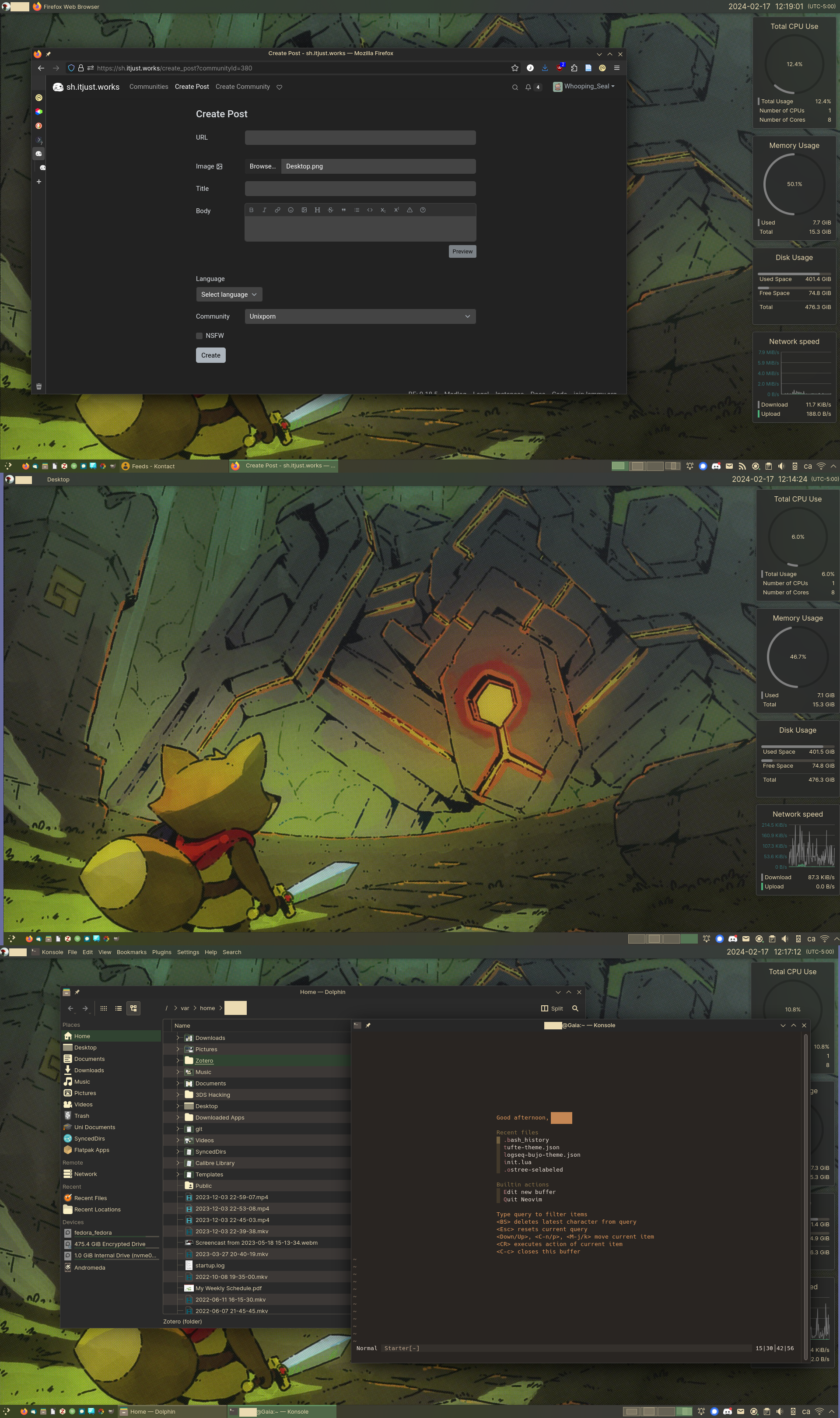
I think I started back in the day with Ubuntu Gnome, with some dabbling in Manjaro and then Arch.
But since then I have used Fedora Workstation, and then Fedora Silverblue / Fedora Kinoite (immutable versions of fedora, with the past several years on Kinoite [kde] over Silverblue [gnome])
On the server side of things, I am using Debian (with everything running in podman containers).
If I were to consider migrating, it would be to migrate my laptop to secureblue (likely, rebasing the OS image rather than clean-installing) and migrate my Windows 11 desktop to bazzite. Both of these are still based on Fedora’s immutable base, albeit with changes to the base OS image. At some point in the future, I would also consider migrating my server to an immutable OS, however, which one remains to be seen.