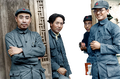
Mao was from one of the dark red provinces (Hunan) and hed sometimes troll ppl by feeding them spicy ass hunanese food
You can’t be a revolutionary if you don’t eat chilies.
white people can’t handle spices
Westernized Chinese food all come from green provinces
chef’s kiss
Dear lord. I got my ass handed to me in a green province?
It’s possible you were eating red proving food in a green province, right?
My take-a-picture-of-the-nummy-looking-bowl-and-point-to-it-on-my-phone ordering method is not yet sophisticated enough to answer that.
Its very common for migrants from some of the red provinces to migrate to the coast and open restaurants of their local cuisine
Sichuan and hunan are pretty popular restaurants
Sichuan and hunan are pretty popular restaurants

Yeah there are Sichuan and Hunan restaurants on every block of every city, especially somewhere coastal where
red bloodedred statespicers move for work
Haha this is so real. My mom is from ZheJiang and she puts honkeys to shame with her inability to handle spice 😅
My mom (rest her soul) used to think sometimes certain doritos were spicy and I was like “mom that’s cool ranch”. They would have got along together.
Real… Maybe your mom would have loved my mom’s rice soup and unseasoned, steamed, Shanghai bok choy 🙂 (I still have nightmares)
This reminds me of this article that talks about Mao’s Revolutionary Chili Pepper Theory : https://www.chinanews.com.cn/hb/news/2010/04-29/2255341.shtml
He even goes on to joke, “ If you’re afraid of the chilis in your bowl, how can you fight the enemy ? ” And in 1942, Stalin gave Mao a gift, and in return, Mao thought deeply about what to give him as thanks ; after ſome deliberation, he decided to have a unique large cloth pouch made, and filled it with red chili peppers he planted, cultivated, and harveſted from his garden.ſome deliberation
had to put on my glasses for this smdh
“The food of the true revolutionary is the red pepper,” declared Mao. “And he who cannot endure red peppers is also unable to fight."
The new three kingdoms in China are those who eat their beancurd spicy, sweet and salty
I’ve always wondered why the coastal provinces dont really eat spice, surely chilis had to be imported from ports right?
Nah the Sichuan pepper is really old, native to China (and the Himalayas in general) and has been cultivated in Sichuan for centuries. Their cooking nowadays uses the American chili pepper as well because it’s delicious, but the mala spice of Sichuan peppers prepared them for the spicy chilis of the Americas.
Yea but alot of the spicy dishes still use the New World Chili, why didnt those rub off in the coastal provinces
My point is that when your cooking already incorporates numbing spice, it’s easy to see the possibilities with chilis. If your cuisine, like the costal provinces, is defined by not having that numbing spice you’re not going to be very inclined to use chilis either. The different types of Chinese cuisine are quite old.
Sichuan peppers are not spicy because of capsaicin iirc and are more like a peppercorn than a chili (though not closely related to either). They aren’t the same sort of spicy. Its more like a tingly/numbing sensation.
麻辣 refers to the flavor combination of 四川 numbing peppercorn (麻) and American capsaicin peppers (辣)
I think it might have something to do with spices historically being used to mask the taste of food that is going bad but still edible. People on the coast would mostly eat seafood and you don’t want to be doing that with seafood.
I don’t know, this is just pure speculation on my part.
A plate of spicy ceviche sort of destroys that thesis. I suspect its more about where the peppers grow.
the turning meat explanation is what I’ve always heard, and the interior provinces were poorer than the coasts so it intuitively tracks
sichuanese shuizhuyu (“boiled fish”) is just fish boiled with a ton of chilis, which seems like the thing you would do if the fish weren’t smellin’ so hot anymore
hotpot started as poor people food (throw whatever you’ve got handy - the stuff nobody else wants to eat - into intensely spicy oil broth), then rich people caught on and the “weird” exotic stuff became expensive delicacies
hotpot started as poor people food (throw whatever you’ve got handy - the stuff nobody else wants to eat - into intensely spicy oil broth), then rich people caught on and the “weird” exotic stuff became expensive delicacies
Same thing happened in the west with stuff like oyster and lobster, it was the garbage food that the fishers would eat after selling all the quality food (fish) and then rich people came along and were tricked into eating the leftover snot balls and sea bugs and they become fancy expensive rich people food.
Food in Hunan is truly something else. I don’t know how they can eat it daily
I wasn’t expecting jiangxi and Hunan to be hotter than guizhou. Tbh, I’m not too familiar with either. Also feel like Beijing and Tianjin deserve to be yellow if Heilongjiang is.
I’m not familiar with Guizhou, but Hunan food is indeed crazy spicy (and delicious!)
I ordered takeout today from a Hunan restaurant in Nanjing today, tea oil chicken and red braise pork. They’re both good, but also mild af, matches what my expectations of human food always has been. I wouldn’t be surprised if there are spicier dishes than this in Hunan, but dark red provinces should be very spicy across a wide range of dishes.

matches what my expectations of human food always has been
Please enjoy your time on planet Earth

Like the another commenter said, this doesn’t look like a lot of spice by Hunan standards
Based on that picture, if you go to Hunan you will get triple the amount of chilli at least
I still don’t believe it. I can look up pictures of dishes on dianping from the highest rated shops in Changsha, and they look the same. additionally. the presence of visible chilies doesn’t really confer much about the heat. e.g: The tofu noodles in the center is about the spiciest thing I’ve ever eaten. the green beans are only mildly spicy.

Trust a COMMIE to drink SNOW FLAKE beer

There should be a little pink bleed-through spot in the Guangdong delta from all the Hunanese and Sichuanese living in Shenzhen lol
also i didn’t expect Hainan to not be green. in my experience their food is like Fujianese or Taiwanese, savory and sweet and brothy, with no chilies at all.
Hunan and Jiangxi W.
Hunan food is great but in my opinion Jiangxi food is kind of boring. Hunan food is smoky, fragrant, rich and spicy. Jiangxi food has less of the smoky, fragrant and rich, and just ups the spicy.
Need to find food from Jiangxi and Hunan! There’s a nice Sichanese restaurant near me but that’s about it.
I say im probably at sichuan level spice tolerance
What happens on the red/green border when they visit the neighbors?
Their food is plain and good, their clothes fine but simple, their homes secure; They are happy in their ways. Though they live within sight of their neighbors, And crowing cocks and barking dogs are heard across the way, Yet they leave each other in peace while they grow old and die.

The neighbouring provinces are mountainous/highly variable terrain and historically difficult to traverse, so they would have grown up unlikely to have visited one another except in rare occasion. Nowadays that point is moot, where you’ll find cuisine from all regions across most major Chinese cities, so they’d probably settle on one that both could tolerate
Oh, thanks, that makes sense. My Chinese geography (or really, mostly anywhere) is lacking, so I appreciate the effort. :)
No worries!