In France, the ministry of Economics just announced that 13000 millionaires did not pay income tax in 2025 … and our social security (health insurance, jobless minimun income, etc) was founded on the principle of taxing the wealthy. So they (liberals) now say that social security is not working as intended and the state should delegate these things to “for profit” organizations … for “efficiency”
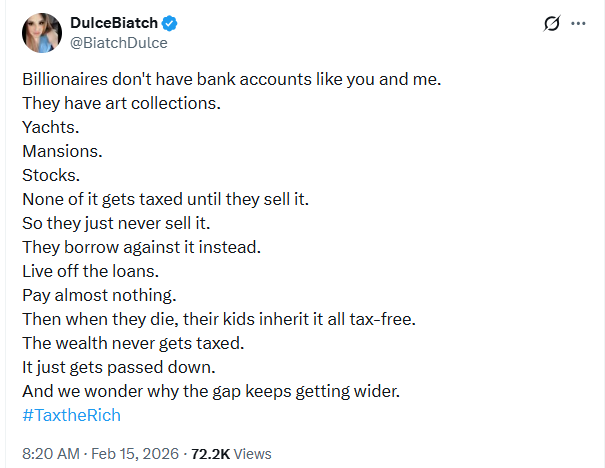
Buy borrow die is a very real economic strategy.
Acquire assets, never sell them, use them as collateral for bank loans, use that capital as collateral for further bank loans. Never sell, no capital gains tax.
Bank loans aren’t considered income therefore not subject to being taxed.
Die rich, your kids inherit the money Scott free.
Don’t the unpaid loans get collected from the estate upon death, and the inheritors get whatever is left?
Still a tax dodge, but sounds like the wealth would reduce each generation?
I also still agree capital concentration is still occurring. Probably due to those loans getting used for excessive gains on the stock market. But those buys and sells would trigger capital gains tax.
Again not saying I’m ok with all this wealth concentration, just feels like a lot of nuance is missing here.
I was being concise so as to keep the comment short. But I recommend you look into it. It’s a very real thing and it’s completely legal.
They set up LLCs in Nevis, a tiny island nation that doesn’t disclose who owns what business. The filthy rich use these mailbox businesses to buy real estate, and launder money. None of it can be traced back to them.
They also inexplicably all have grand pianos.
they have tax accountants, legal advisors plus they squirrel away money to foreign banks, like swiss, deustche bank.
There are high security warehouses that lease space to store billionaires’ art collections. That’s one of the “banks” they use.
Henry Ford said, “It is well enough that people of the nation do not understand our banking and monetary system, for if they did, I believe there would be a revolution before tomorrow morning.”
The percentage of sociopaths involved with creating a society should never be greater than zero.
Financial obesity is an existential threat to any society that tolerates it, and needs to cease being celebrated, rewarded, and positioned as an aspirational goal.
Corporations are the only ‘persons’ which should be subjected to capital punishment, but billionaires should be euthanised through taxation.
this is also pretty good vulnerability, should people start to think at somepoint that maybe billionaires shouldnt have all the wealth in the world. I wonder how the ones who have loaned them money would feel if the asset they have loaned the money for would just… go away.
Any person should consider billionaires like foreign occupation.
Oh was that why they threw the tomato sauce on that one painting? Now it all makes sense
Yep.
Saw a vid about doing that recently. https://www.youtube.com/watch?v=YsDsDqIxgfg
And when I searched for that again just now, saw there are dozens of others too, about “borrow until you die” and similar. “Tax is for the poor” they say.
So much for progressive tax system.
The whole system (not just the tax system) is broken by design.
Yup, search for “Buy borrow die” and there are various articles about the technique.
This is basically urban legend at this point; “buy borrow die” is a tiny piece of the ultra-wealthy’s financial strategy, at least when it comes to the “borrow” part, which is what everyone’s focused on:
-
In reality, the ultra wealthy do not borrow against a large fraction of their unsold gains. On average from 2004 to 2022, the top 1% of wealth-holders only borrowed 1-2% of their annual economic income.
-
Borrowing while holding unrealized gains is, in fact, more of a middle-class activity than an ultra-wealthy one: Americans in the 50-90th percentiles borrowed 42% of their unrealized gains in 2022, compared to just 4% for the top 1% of wealth-holders.
-
The primary tax avoidance strategy for the top 1% is not to borrow, but simply not to sell appreciated assets.
On average from 2004 to 2022, the top 1% of wealth-holders only borrowed 1-2% of their annual economic income
What’s confusing to me is that there must be a reason they’re borrowing. When you borrow, you have to pay interest. If you’re someone who has a lot of money, why would you pay someone to lend you money? I guess the only thing that makes sense is that they think that whatever makes them rich, say Amazon shares or something, will go up at a rate that beats the interest rate they have to pay for the loan. OTOH, I guess they’re not so sure of that that they borrow in order to buy even more Amazon shares.
The primary tax avoidance strategy for the top 1% is not to borrow, but simply not to sell appreciated assets
I assume this means “not to sell all of their appreciated assets”, because they do spend a lot of money and it has to come from somewhere.
The reason the rich borrow money is to take advantage of tax loopholes. It’s not about being reasonable or what ought to make sense. They are gaming the system, that’s it. So, how does it work?
If they have investments in the stock market, then they get taxed when they sell those. So even though the investments are usually going up in value, they don’t want to sell too often. But they still need to buy things.
So, where do they get money for living, houses, cars, travel, etc? If they get paid for working a job, their income is taxed a lot, meh. If they sell their stocks, they get taxed a little, meh. But if they get a low-interest loan, that money is not taxed.
And you might say hey, money’s gotta be paid back some day. But remember, the goal is to find the loopholes, the places and times where either you don’t pay tax or you pay much less tax. And those loopholes are all over the place. In the end, the details are just boring. Most financial scams have just enough moving parts to look amazing, but if you take an hour to figure them out, it’s nothing exciting.
The reason the rich borrow money is to take advantage of tax loopholes
Ok, what tax loopholes?
A basic one is negative gearing + trusts + cheap loans.
Negative gearing allows you to deduct/combine different income streams together to reduce your taxable income, and hence tax liability.
Traditionally used by middle/upper middle class to deduct mortgage interest payments and reduce their taxable income.
Rich(er) people combine this with trusts to distribute income/expenses among trust beneficiaries for something more tax advantageous. Usually this is someone like a spouse, child, or extended family member.
Add on the fact that rich people get cheaper loans, which often makes it cheaper to finance day to day life with loans, and only draw down (ie realise capital gains) after shuffling around incomes/expenses for a year.
Tax loopholes are basically legal ways to shift the timing and benefiary of income/expenses. There’s a bunch of other ones, like
- choice of depreciation calculation
- purchasing things on behalf of a “trust” or “company”
- getting paid in low tax jurisdictions
- moving money into tax advantageous retirement accounts
None of that explains anything for wealth levels we’re talking about. Negative gearing implies a loss elsewhere, trusts max out at the same rate as all other inheritance they just avoid probate, retirement maxes out way earlier than what they have.
Nope, they definitely do. The specific assets and schemes differ across wealth levels and also across time as laws change, but the general principles of finding and exploiting loopholes remain the same.
The middle class negatively gears property despite the property gaining in capital terms. The ultra wealthy negatively gears sports teams despite the team gaining in capital terms.
The middle class deducts fancy electronics and cars as “hobbies”. The ultra wealthy deducts entire luxury hotels and horse racing clubs as “hobbies”.
The middle class stuffs income into retirement accounts. The ultra wealthy stuffs assets, which are way more fungible in value, into retirement accounts.
The Secret IRS Files Archives — ProPublica - https://www.propublica.org/series/the-secret-irs-files
Ten Ways Billionaires Avoid Taxes on an Epic Scale — ProPublica - https://www.propublica.org/article/billionaires-tax-avoidance-techniques-irs-files
More Than Half of America’s 100 Richest People Exploit Special Trusts to Avoid Estate Taxes — ProPublica - https://www.propublica.org/article/more-than-half-of-americas-100-richest-people-exploit-special-trusts-to-avoid-estate-taxes
Businesses. I’ve seen ‘the back end’ of an upper middle class family with a business, and the ways the mother (the tax genius of the scheme) moved money around and labeled various things as expenses for businesses was wild. None of it was illegal, it just was clearly not the intended purpose of the tax laws. One example I clearly remember was sticking five cattle on each of the properties they purchased, and all taxes just disappeared (went from thousands of dollars to just… dollars) due to agricultural exemptions. All of the cattle and their care suddenly became expenses, because the labor they hired to care for them was somehow completely deductible or expensable or however the law looked at it, which allowed them to shuffle money from another business to make it look negative…
and so on and so forth. I think they had more than four businesses that were legally separate (and incorporated, with the board being family members [and those family members are part of a trust that let even more shenanigans happen]) but supported the way money was shuffled. This was for a family that, at most, made ~ $500,000. Super high, above that 1% mark, but not even close to the insanity that the truly wealthy can pull off. Anything business related opens up an exponential number of ways to move money, even while using it, compared to the options a casual income-only tax-payer has.
As much as we can point at ‘Trump, dumb’ and tell ourselves that the rich are stupid but lucky, the majority are not at his level. They hire (multiple) people making six figures to manage their money because that investment pays off.
I cant blame them, honestly. And I think 99.99% of poor people would use the same strategies if they could. This is not about being morally superior, its about finding ways to keep your money. And this is something everyone is interested in.
Unfortunately only the rich can use this strategy in practice, but we all would if we could.
Neat doc, thanks for linking. I find this part very sensible in light of what you brought up
In most cases, the ultra wealthy don’t need to borrow, because their liquid, taxable income—salaries, business income, and capital gains—is significantly higher than their annual consumption.
That makes sense… I mean once you’re somehow generating millions or more every year in income, no need to borrow at all really. It’s making it to that upper tier of income vs. expenses that few reach.
Tax the Rich, the Old Fashioned Way: Raise Rates
That’s the key thing.
-
Tax portfolio loans over a certain amount. That’s pretty much it. Sure, there will need to be some moving parts beyond that, but basically if you treat a loan as an income rather than something like a primary residence purchase in the buyer’s own name, it gets taxed.
I think the ‘unrealized assets’ should be taxed as ‘realized’ if they are used as collateral. Yes, it would affect the reverse mortgages and such, or home equity loans, but fuck it, I’d take those relatively small pains against the massive societal gains.
Reverse Mortgages are usually predatory anyway, so more scrutiny and regulation isn’t a bad thing.
Yes, this. Tax collateral as advance on capital gains and the whole incentive to dodge taxes with loans go away and it remains fair too
You could make exceptions for loans taken to improve the same asset (home improvement loans) but you’d have to pass strict audits to get the exception approved
I don’t know what the financial consequences would be. Taxing unrealized assets would also have to have limits because so many retirement funds and the like are unrealized gains, we don’t want to hurt people’s ability to retire. That’s why putting a tax on trying to sidestep paying capital gains makes more sense. We’re not going to figure out how that all works here today. People won’t sit on unrealized gains, they’re going to have to use them in some fashion even if just as collateral, and we need to tax whatever workarounds they use to make those funds work for them.
The rule applies for people with billion dollars of assets.
They divest the assets into holding companies, like they already do, held by LLCs.
Then make it also apply for LLC, or for everyone except (list). I mean every set can be quantified.
No. Not every set can be quantified. This is real life. You have a limited amount of resources and manpower and you have to get the most money with that limited pool.
The less resources you have, the lesser and more imprecise your information becomes. Solutions that require even more precise tracking of even more entities, with endless resources for legal battles, is the opposite of a solution.
They need to fund the feds and give them enough to effectively use the tools they already have.
But then LLc’s can also be legit businesses, and sometimes moving money to an LLc can be a legit investment in a company and not just a shell.
Look, I already said there’s a lot of moving parts here and and we’re not going to solve it on Lemmy, so no need to keep getting in the weeds over this issue.
The devs never patched the infinite money glitch.
The oligarchs in the US are the utlimate power behind the destruction of our democracy. They have stolen the wealth from us for decades. And yet so many of our citizens defend them because they might be rich one day. Which they won’t. Because the ultrarich already there won’t let them.
Guillotines are long overdue.
We don’t wonder anything. If you were wondering, you never bothered to think about it for more than three minutes.
And your comment has what to do with mine?
One word: Land value tax.
Every time I see a post like this I am disappointed that NO ONE mentions Henry George.
People, please, go educate yourself. Taxes were solved before ww1.
Technically three words.
I’m german speaking. So for me, this is one word ;)
Fun fact, in German the entire Bible is just one word!
deleted by creator
We Swedes can get in on the verylongcompoundword fun too
Why’s that? You stated your opinion knowing that many people are ignorant of it, but failed to back it up. Why should we research your idea when we have ideas of our own? Don’t suggest we’re ignorant if you’re not willing to take the first step in educating us. Your contempt feels good but doesn’t solve any problems. Ciao
I feel you and I’m glad you asked. The goal of my comment is to invoke interest so one can go down the rabbithole on ones own terms. This has a much more sustainable effect than just serving information on a boilerplate nobody asked for. Much like a catchy title/thumbnail on a yt video generates clicks, but the actual information does not.
There are a lot of resources about LVT out there including some educational videos in an entertainning way. Pick your own poison: https://www.youtube.com/results?search_query=georgism
My Standpoint: Our present tax system is bad (almost worldwide): Tax based on value generated (like income, sales and import taxes) costs society a lot (real costs but also opportunity costs) while simultaniously not solving a lot of todays issues (f.e. tax evasion, old money, zone planning / car centric design, pollution, etc.). Land Value Tax (or more precicely: Resource Tax) solves this by getting rid of the penalty for being productive or creating value while simultaniously taxing those being exponantionally wasteful with resources and/or pollute.
With LVT, there is now a penalty free incentive to increase profits and/or efficiency. On the other hand, if you consume and/or occupy resources like land, oil or air pollution, you’ll have to pay tax for that derived from the resources scarcity. The sum of the tax would be similar or higher than todays sum and would finance all government spending including a citizens dividend which could be interpreted today as unconditional basic income which would provide for basic human needs.
Georgism is PRO Economy and PRO Humanity. Win Win. Regardless of your political flavor, you should be in favor 😏
Winners: Society, everyone from poor to rich, resourceful entrepreneurs
Losers: old money, polluters, unrighteous beneficiaries of today’s flawed legal situation
That’s a great pitch, thank you, I’m sold. appreciate the work
I worked for 5 years to promote LVT.
In real life it’s far more complex to administer than a straight property tax, that’s why it will never be popular. It also creates bizarre outcomes where where it rewards some land uses and punishes others and creates weird incentives about land topology and parcelization.
Who is going to assess the value of the land as distinct from improvements? Geologists? Environmentalists? Different parents will presume different values and push those values. Property taxes are assumed basically based on other similar properties on the market, in terms of size, age, and space. But 2 parcels of 2 acre right next to each other could be radically different values depending in there topology and environments. I lived on a 2 acre parcel once, and our neighbors had 1/4 acre plots, but our 2 acres was mostly swampy low lying land that was not adjacent to the part the land our house was on that was regular. It was also weirdly shaped and the ‘access’ to it was a narrow 10ft corridor. It was essentially… useless land attached to our parcel, we couldn’t even develop it because in order to clear it you’d have to get permission form your neighbor to drive construction equipment across their driveway/lawn and destroy it. The extra ‘land’ in our case added 0 value to our property and in fact removed value, as houses around us were often selling for more due to the extra liability our extra land came with.
It introduces just as many problems as it those it claims to solve. It makes sense in some limited contexts, like say, urban land use across small and regular parcels, but not all land is urban land.
You forget that George was writing when society 70% agricultural and rural and working off a model of undeveloped land. in 2026 only 17% of the USA population lives outside of cities.
Finally a fellow georgist. How does one work to promote LVT? You mean you got paid to do it and despite that, you are now against georgism?
IMHO, your reasoning is weird and blown out of proportion. Measuring value of land and housing is easy and is done today for the market, for insurance and for taxing purposes. This could be a reason for georgism to become unpopular, but it isn’t a reason against georgism.
in our case added 0 value to our property and in fact removed value
The common reasoning with negative value land. This is only brought up because it is an issue in todays world. It wouldn’t even be an issue with an LVT. If a strip of land is only costing money, just give it back to the Gov so they need to take care for it, you’re not a charity. Otherwise it has a measurable value which you are denying to win an argument.
It introduces just as many problems as it those it claims to solve.
No it doesn’t. I see one “Problem” LVT doesn’t solve, but you haven’t mentioned this one yet.
It makes sense in some limited contexts, like say, urban land use across small and regular parcels, but not all land is urban land. You forget that George was writing when society 70% agricultural and rural and working off a model of undeveloped land.
This is not valid. George focused on New York. It did include everything from agriculture to fully developed Manhattan. It’s called Land Value Tax, not Land Tax.
No, i actually worked with economists, lawyers, and assessors on research projects. And everyone of them loved LVT in theory, but in practice sucked balls. Again and again, the research showed poor and awful outcomes when the direct implementation of the tax was studied and various municipalities that have tried it have totally and utterly failed and gone back to a property tax due, largely due to the overwhelming overhead costs involved with assessing and administering a LVT.
There is a huge gulf between theory and practice. Georgists sit around all day and theorize and idealize but never actually go into the trenches of tax law, tax policy, and tax enforcement.
Very interesting. Do you have any sources to share so I can read into that?
Also, I believe there are 2x publicly known sources for LVT being applied on a wide scale: Alaska and Singapore. Both are very successful and comfortably perform far above average compared to other US states / other countries. This somewhat directly contradicts your statements. So maybe your experience is not representative for LVT’s performance, but rather your specific execution of it.
Just to be clear, LVT is just one form of resource tax. Actually all resource use including pollution and oil extraction etc. fall under my understanding of georgism.
Georgism is an ideology.
They think the LVT will solve all social problems ever. That’s the premise of the book he wrote about it.
He’s basically like Marx, but instead of communal ownership of production he thinks taxing land value will solve all society’s problems. Like communists, Georgists think if you just read this book and BELIEVE poverty will disappear.
The LVT has a lot of merits, but it has lots of drawbacks. It’s difficult to value land as district from property, for one. It would also be highly inaccurate in the case of mineral rights and other factors.
Your comment doesn’t have any value.
let me use it for capitalism:
Capitalism is an ideology.
They think the market will solve all problems ever.
He’s basically like Marx, but instead of charging for the use of something, he thinks taxing work and output will solve all society’s problems. Like communists, Capitalists think if you just understand economy and BELIEVE poverty will disappear.
Capitalism has a lot of merits, but it has lots of drawbacks. It’s difficult to punish someone for working, for one. It would also be highly inaccurate in the case of different amount of use of resources.
That’s true of all ideologies, they are ideal theories that have no basis in reality.
Reality is a mix of various ideological systems and beliefs interacting with each other.