

You went full stupidpol, man. Never go full stupidpol.
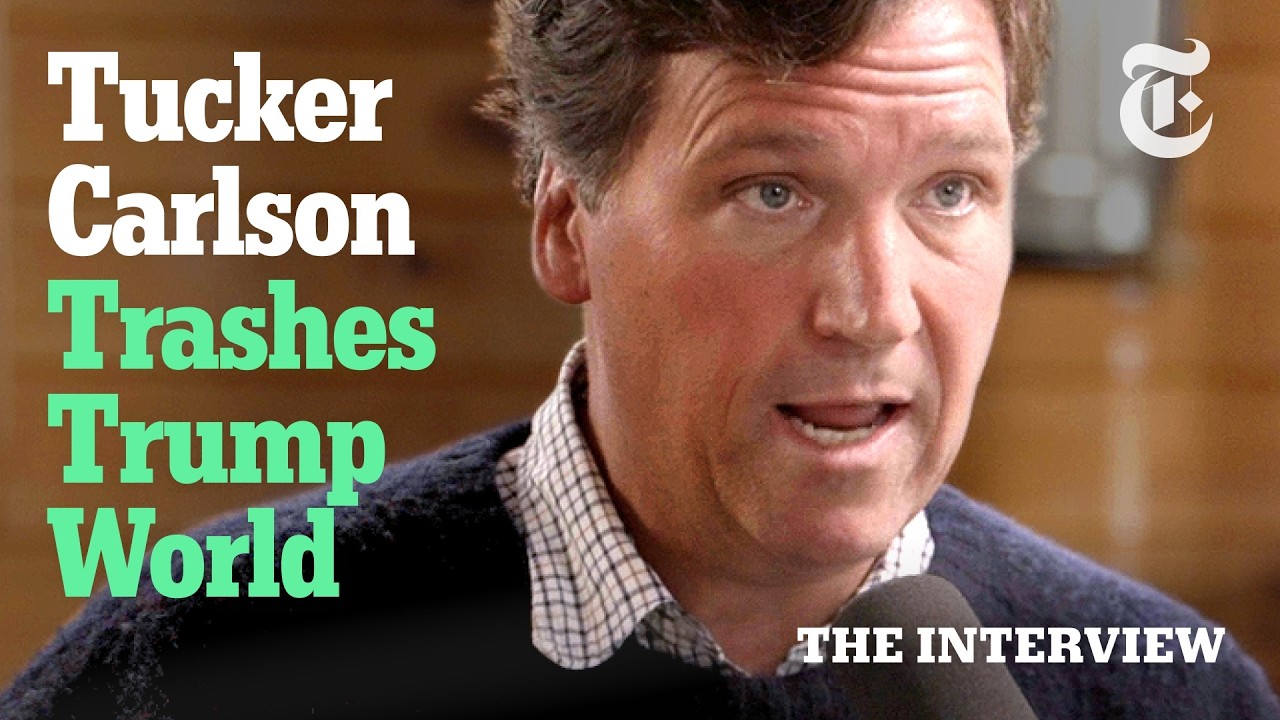
Maybe just because I wanted an excuse to use the “Tuckerpost” flair, I’m sharing a transcript of several moments from the NYT’s latest interview of Tucker Carlson (which reveals itself throughout the video to be an attempted character assassination for his Israel-critical commentary). The parts I transcribe are entertaining to me in that it’s essentially a 2026 update of Tucker’s viral communist Tucker Carlson meme from some years ago, while the interviewer subtly rehashes Hillary Clinton’s if I broke up the banks tomorrow response to Bernie.
Bonus points for mentioning Occupy Wall Street.
As for Tucker’s true intentions, the common take I see on stupidpol is that he’s an opportunist using the lingo to coax leftists into voting GOP. I think that ignores what seems like a genuine disillusionment with the Republicans, but he’s clearly not actually a socialist by any stretch. It seems that the populist edges of the two-party system will continue to blend and blur in confusing ways as the contradictions of the capitalist system reach a breaking point.
Anyway, here goes:
Interviewer: Given how influential Fuentes is right now-
Tucker Carlson: Is he?
I: Is he not?
TC: I dont know- doesn’t seem to be- he didnt get us into a war with iran. Like who cares actually? That’s kind of what I’m saying: All of this is a sideshow. Americans are being killed in a foreign country at the behest of another foreign country, and it’s going to wreck the US dollar and cause hyperinflation on our country, and we’re fretting about what some- kid on the internet said. It’s like, who cares?
Actually, this is a way of taking us away from the core issues which are economic. They’re economic. And that is the one thing that nobody ever wants to talk about. How is the money distributed? Where does the money come from? No one wants that. That is why the only left-wing movement I’ve ever had sympathy for was the one that arose after the global financial crisis, Occupy Wall Street. (1:17:22)
I didn’t know exactly what they were about, but I was like “yeah, we should be mad at the banks because they did this and nobody got punished. And within, like, 20 minutes we’re talking about black people and white people and-”
Interviewer: -I’m- I’m- I’m happy to talk about economics, but your interview with Nick Fuentes has 25 million views…
[Further quibbling about the importance of Nick Fuentes]
TC: (1:20:45) Race is thrown up as a distraction, so often as in this case, to distract from the economic matters of- Fuentes, himself, is a distraction from the conversations that matter. Because power is displayed through the structure of the economic system, globally and in our country, and in the use of force. So the economic program and the foreign policy program are what matters, in every government from the beginning of time. Those are the two questions on which there’s a bipartisan consensus in Washington that we should do this thing. The public rejects that thing, on both categories, they reject the economics and they reject the foreign policy consensus choice in Washington. So Washington’s response- Wall Street’s response- is to go, “Let’s have a race war…” … "And so Fuentes is incredibly useful for people with actual power to divert the conversation to something that is both irrelevant and divisive.
"We can argue about the trans thing, and you can have legitimate views on race, legitimate views on trans. Those are all real issues, I’m not saying they’re not. But those are not the issues on which empires rise and fall. The real issues are on economics and foreign policy, and on those issues there’s a bipartisan consensus. And so they throw up, ‘We’re disagreeing on trans or on affirmative action or whatever’, but they agree on everything that matters . . . And so everyone wants to talk about Fuentes because it’s really safe. No one wants to talk about: Why are capital gains taxes half those of taxes on regular income? I think that’s a critical debate. points at NYT interviewer You will never have that debate. Have you ever asked that question? And I think nothings more important, domestically, than that. But whatever, that’s my opinion.
That is the second time in this interview that Tucker explicitly asks, “Why is capital taxed half that of labor?” (54:47).