

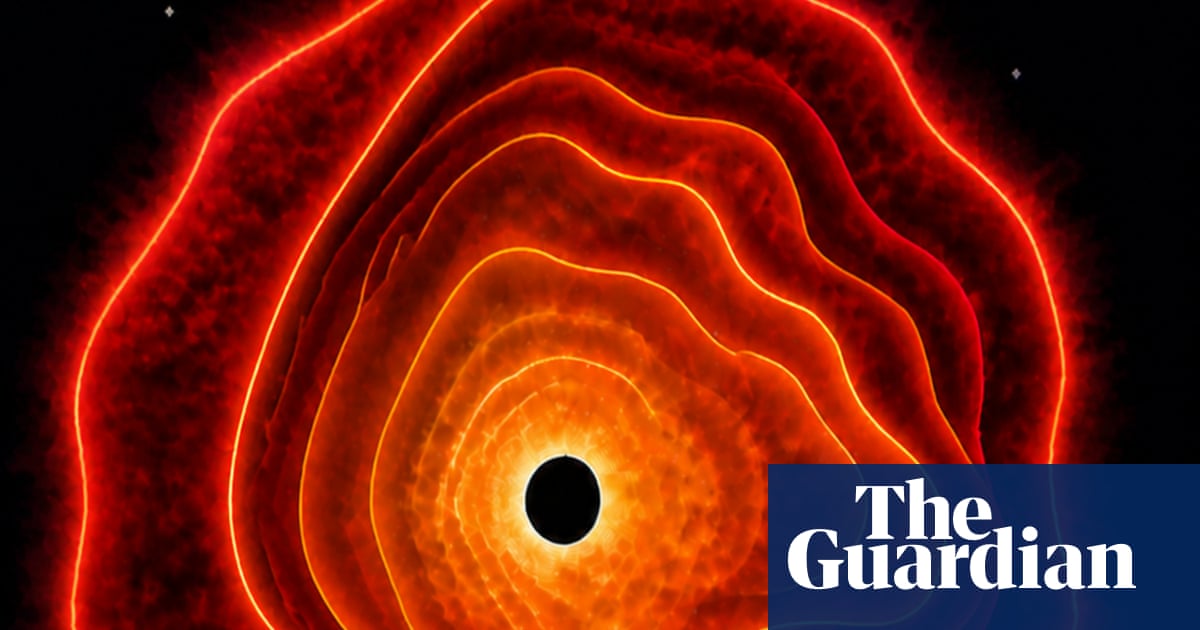
cross-posted from: https://sopuli.xyz/post/50636987
See also Wikipedia. Apparently this is the first time a candidate for an object like this was discovered.
I think Soundgarden had a song about this.
And I thought this was the cover of songs in the key of life by Stevie Wonder
In my eyes
Indisposed
In disguise
As no one knows
Hides the face
Lies the snake
The sun
In my disgrace…
🎵 🎶Boiling heat
Summer stench
'Neath the black
The sky looks dead
Call my name
Through the cream
And I’ll hear you
Scream again 🎶 🎵
The title is misleading. It’s not “discovered”, but rather “observed for the first time”. Since black hole stars have been theorized for a while now. And they’re actually the only “accepted” explanation for the origins of super massive black holes holding galaxies together.
Not even observed for the first time, it’s more like one group of scientists believe that they have observed one with one publication.
Wow! JWST is paying dividends like this on a regular basis. It’s amazing what can happen when humans around the world collaborate on something instead being at odds.
They might be the seeds of present-day supermassive black holes, such as the one at the centre of the Milky Way.
Oh fuck oh fuck
I read something a while ago speculating that black holes, and thus the singularity and infinity problems inherent with their existence, may not actually exist.
Rather, they were proposed to be basically this, stars which are super dense, and do cause light to fall back into them, but rather than reaching a point of infinite density, the stars themselves lie just beyond the event horizon, so we can’t see them. Totally normal physics, just super hugely massive objects.
They called them gravetars, I believe.
Edit: gravastar, it turns out. The paper I read was something more recent than 25 years ago, however…
The GR (general relativity) equations predict a singularity so it’s a big theoretical puzzle. I don’t think anyone believes there’s really a singularity. They just think GR needs correction at the microscopic scale (i.e. quantum gravity) and no one currently knows how to do that. Progress is being made though.
Look up “ultraviolet catastrophe” for a historical analogy from thermodynamics.
Unrelated: I wonder if AI has had any impact in analyzing the data from James Webb
I suppose it depends on what kind of AI we’re talking about. If you mean LLMs, then I certainly hope no one is trying to do something as foolish as that.
A lot of the stuff from James Webb is truly novel, as well, which no AI technology would be useful in understanding.
My understanding is that AI has made surprising success in mathematics in novel unsolved problems.
So it does seem apt for this use case
Not LLMs though. Especially GenAI
Of course. That’s just garbage
At least in my field people work with AI to write code and find information, so I assume whoever is making the data analysis for James Webb has done the same.
For using neural networks to actually analyse the data I’m not sure, because the goal of these analyses is to understand, and not just to classify. That being said, for known phenomena with lots of training data, neural networks may help. But (not really knowing, but based on my hunches) I would say that they use some explainable and understandable stochastic methods to find candidates for something that was never observed before, such as a black hole star.
Feel free to do a literature search and prove me wrong though :)