
You must log in or register to comment.
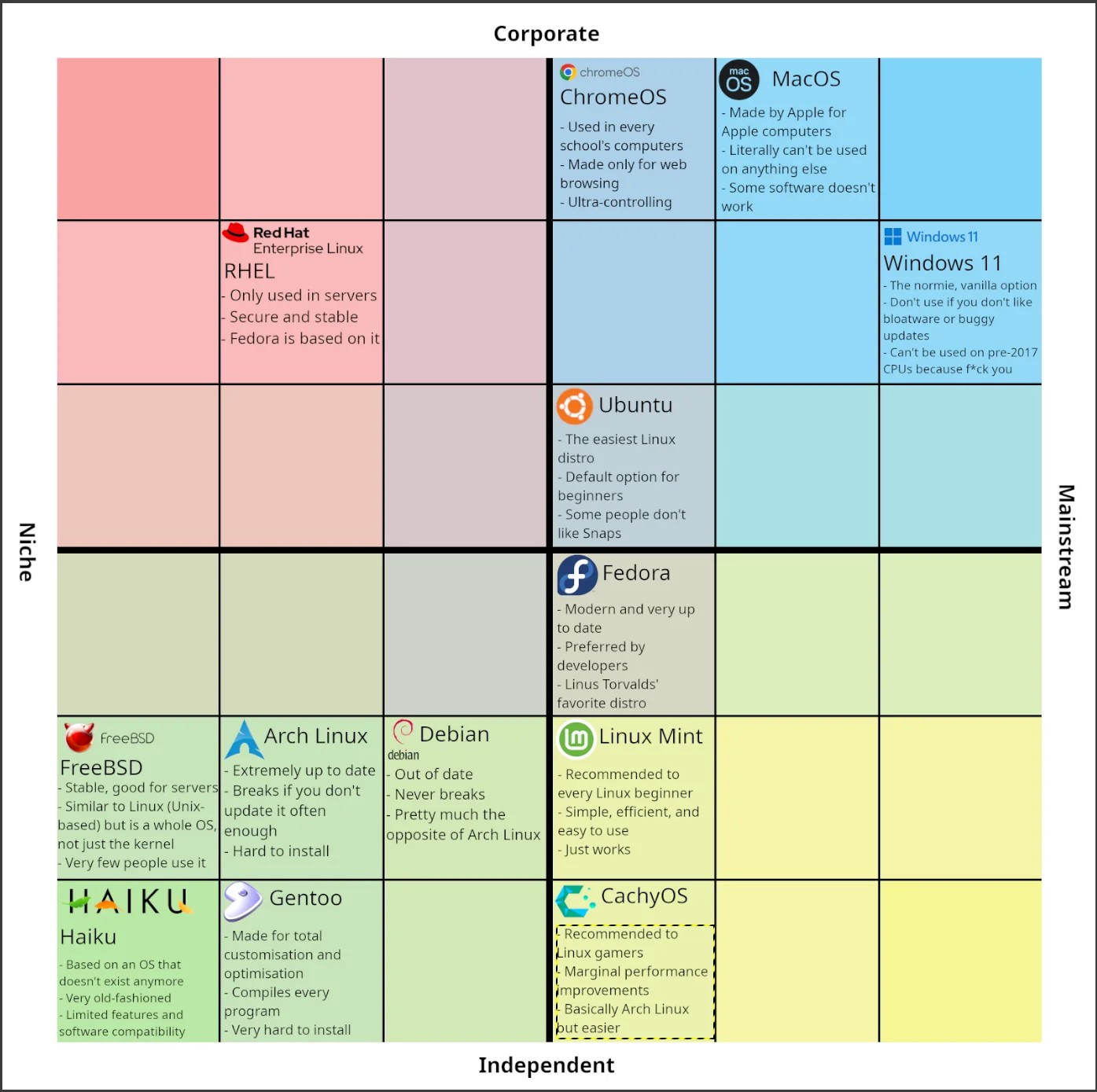
Where would the Bazzite operating system fit in?
Hannah Montana Linux in the far bottom right
My take

I think you’re missing quite a few like:
- z/OS it’s IBM’s mainframe OS, so super corporate and niche
- raspberry pi os should be included because it’s pretty mainstream
- android and iOS should be on there because they’re very mainstream, not technically desktop OSs but for a normie with a tablet what’s the difference?
- there’s a lot of embedded OSs that could be added (open WRT, Windows IoT, NetBSD)
- no Temple OS?
- free DOS?
- Whatever special ones they use for super mission critical stuff like the ISS
Ubuntu easiest Linux distro
Hahaha it’s a noob bait
hasn’t been the easiest in about 7 years haha
GUIX top left
- dictates to the OS how it has to be
- requires a lot of reading theory
- no ties to anduril
nixOS top right
- dictates to the OS how it has to be
- recruits people snatchers
Edit: Ah I missed the axes are not labeled like the common political compass. Nvm then. Put NixOS above RHEL and guix above arch.
NixOS is definitely not as corporate as MacOS or ChromeOS. It’s also not as mainstream as RHEL. I’d say RHEL should be one square to the right, NixOS should go where RHEL is now, and Guix should share the square with Gentoo.
Hmm, I don’t see how Corporate can be on a scale though. Either the distro is run by a corporation, or it’s not.
i think an OS can be made entirely by a corporation, or entirely by one hobbyist with no funding. something like fedora is made by volunteers with corporate funding, whereas something like Arch is made by volunteers with donations, some of which might be coming from corporate representatives
macos is very controlled. windows is closed source but an open system. runs on many devices.
LOL at Windows being marked as less corporate than MacOS. They should absolutely be at least tied.
Literal megacorporations have run purely on Windows since the 90s and it’s not S-tier corporate? lol
Windows is not at the top of corporate possibly because it can be installed on non-homologated PCs.
But on the other hand, all the reasons that people hate corporate OSes apply much more to Microsoft than Apple. Microsoft is the company that puts ads in their OS and is built entirely out of proprietary tech, and has been more vocal about shoehorning AI into everything.
That’s a poor qualifier. Most corporations do not deploy MacOS to their employees. Windows belongs in the top right, if not a full line by itself for Corporate.
Fedora is basically a testing ground for the next RHEL release.
RedHat: noooo, fedora’s definitely for sure independent. you’re not just doing free labor for IBM
Red Hat is their biggest sponsors, and uses their releases to bugfix and create their new releases. But just because Red Hat uses it this way, ofc doesn’t mean Fedora isnt independent, it just means they are very influenced by a HUGE donor!
Are there specific choices made by fedora that would have should have been done differently but were pushed by the large donor?
Just asking because I’m on fedora but wasn’t aware of that relationship but this description hasn’t yet convinced me that the relationship is toxic for users, but my mind is open enough to believe it with specific examples.
The thing is, we don’t really know really. The only thing we know for certain is that Fedoras rollouts is basicly a testtube for Red Hat. I think Red Hat or Fedora was pretty open about this. It might seem “negative” but I just think it adds an extra layer of caution. I don’t think Fedora is interested in becoming buggy in any way, or irrelevant for that matter. Bazzite for instance also run on Fedora, so that would be crazy. But I also think that they just might implement things IBMs red hat tells them too, if they wanna keep getting those huge donations. Donations at an open source market still benefits the doner in this way. It’s a fastlane ticket to features after doners desire. So Fedora users might just get the rollouts before Red Hat users, and get it with the bugs it might have at early stages, before Red Hat implements it. But I am not in any shape or forme in knowledge of the Fedora team and I don’t know how the relationship works. I just don’t buy the fact that IBM gives millions to the Fedora team without using it for their own advantage as well. Who wouldn’t?
Why isn’t openSUSE included in that table?
You can install Debian on your Chromebook like you would any app, which I feel makes it a bit less controlling since you have access to a complete Debian install and all the benefits that provides.
Windows also has WSL, which gives you Ubuntu, although that process isn’t quite as user friendly.
You can’t take out ChromeOS as you can Windows
Some people don’t like snaps
“Some people like snaps” would have been closer to the truth, but it would still be an exaggeration of their numbers.
I bet Mark Shuttleworth likes Snaps.
“A person likes snaps.”
There, all covered and more accurate than the original.
His mom probably likes them too.
His dad probably says “WTF is this Snap bullshit son? We didn’t raise you like that.”
Then his mom replies, “it’s just a phase, he needs our support, I’m sure you can make snaps happen, sweetie.”
You know what? I know they’re far from the ideal solution, but I have installed a few things with snaps … and it was fine. It worked seamlessly and painlessly (in some instances).
Generally, I’d prefer other ways to install, but snaps aren’t the end of the world.
(This concludes my hot take of the day.)
Yeah those fights are like the nerds dying for Arch. Probably a good thing so that things move forward but utterly useless for lambda users.
Hot Take Day!
It’s not a question whether they work or not. It’s whether you’re okay with an app distribution system that forces us to be dependent on one corporation. Snap’s backend effectively makes Ubuntu almost as bad as Android.
And seeing as there is no shortage of better options, why not choose those?
snaps aren’t the end of the world
System engineers all collectively shuddered at that thought. Then OS security nerds.
This is the “I tried heroin and it was good” story but for OSes
pretty soon we’ll need snaps in our snaps to make it easier for developers to create snaps with snap dependencies
And if I tried heroin and it was bad was also even more common.
What about flatpack?
if you live antwhere but the USA and Canada, MacOS is a niche, absolutely not mainstream at all, I see more linux users than MacBook users here in Brazil
macs are so rare that someone once screenshared and i was almost asking if that was gnome
Lmao. In Europe Mac is mainstream and most people think I have MacOS installed when it’s in fact gnome
Do they not advertise in Brazil? Cuz if y’all can go a day without seeing an ad of a floating laptop doing pirouettes in an endless white void to an overproduced pop song masquerading as indie, I might be down to move.
as someone who has lived 20 years in brazil, (since brith and has yet to venture outside) I have seen one apple ad in my whole life, and zero apple apple stores, the few times I decided to look up some of them because of memes I was genuinely disgusted by them
Oh, didn’t you know? “The World” is just “USA” on the Internet.
I mean…it was invented there. And it is the third most populous country in the world. So, for a long time the Internet was USA. It’s not anymore but change can take a while to sink in.
Just my 2 cents.
deleted by creator
CachyOS being the same level as mainstream as Mint and Ubuntu is copium.
And somehow more “independent” than arch, when it’s based on arch?
It’s the most popular single distro on ProtonDB now, so that’s something
It’s in an extremely good spot right now imo. Just installed it yesterday on pretty new hardware (upper mid-range), flawless experience
Cachy is growing in popularity a lot. Negative publicity around Ubuntu is driving people to alternatives, and I’ve heard a lot of people are trying cachy as their first Linux distro.
People are trying cachy as their first Linux distro.
To anyone reading and thinking of switching:
DO NOT use CachyOS as your first distro. You will not like the experience, it was not made with total newbies in mind. It is Arch with a few bells and whistles, and you are not prepared to properly handle Arch, yet. You will get there later, if you want to.
Ironically, I think Arch might be a better first time distro than CachyOS, because if you’re willing to go through the manual installation process and learn from all the fuckups you’ll make, you can come out of it with the knowledge necessary to manage your install. Though of course I would only recommend it with the warning that your system will be mostly broken for a while and you’d be constantly figuring out and fixing things, so not a good idea if you need your computer working.
But it does seem like a nice distro for if you already know what you’re doing and want to save time getting things set up (and maybe those performance improvements are significant enough, I’ve seen people give big figures)
Agreed! If you want to get into the backbone of Linux systems from the get-go and have some level of technical expertise, Arch is a brilliant learning experience.
And if you already have the experience with Arch and just want to make your life easier, CachyOS or EndeavourOS are good options.
I wish there were Debian with Cachy-gaming features. Wonder if I could just do that myself? 🤔
Debian is probably a poor fit for a gaming-oriented distro, since gaming is constantly evolving in terms of hardware and software features.
Even if you put as much as possible into a container or a Flatpak, your drivers will be old.
If you want stability AND modern gaming, maybe go for something like Bazzite? The system is very stable thanks to immutability and atomic updates, and at the same time you have all the modern gaming stack.
I’m not a fan of immutable distros, and always having the latest drivers has never been an issue for me. Having a system that’s less likely to break after an update is a bit more critical when it comes to actually being able to spend time playing games.
But what I meant is that Debian has tools I can use to recompile my packages. I’m not aware of any reasons why I wouldn’t be able to rebuild my system to replicate the unique features of CachyOS myself if I wanted to put in the work. And at that point I could always start with Sid as a base as well, which would be just as bleeding edge as any rolling release distro.
Or, there is always Siduction as well.
Looked into Siduction - seems to be a small project operating over Debian Sid, which I call a recipe for disaster when actually deployed as a home system. Sid is not meant to be stable, and you’re unlikely to get much support. And a small community project is unlikely to patch everything faster than Debian itself.
Debian Sid should not be seen the same way as Arch or other rolling release distros - the former is supposed to be broken, a bug here and there is a non-issue at this point of Debian development lifecycle. Arch and others are expected to actually be used as end products, so critical bugs are rare.
I had some counters in mind to the things you’re saying here. But I don’t feel like bothering. So I will just say the big problem with everything you’re saying, is that you’re arguing against using Debian.
Meanwhile just last night Elden Ring on my Trixie desktop went brrrr.
If I am used to Ubuntu, would I ever want to be on a rolling release?
Depends on your personal preferences!
Rolling release typically delivers the latest and greatest of Linux, which is kinda cool. It also removes all the headache of upgrading to a newer version and the possible issues stemming from that. You get to see the gradual evolution of your system, one feature at a time, and you don’t have to wait a month after a new version is released, just because some program you need is not properly ported yet.
On the other end, any update of the rolling release system can end up being somewhat breaking, so if you prefer setting aside time for managing your system instead of having a nasty surprise at the worst possible moment and at the same time want to have your system secure and updated at all times, classic model will be superior.
In both cases, properly set snapshots save a lot of trouble.
Yeah, even Bazzite is less niche then CachyOS
yeah, trendy distros come and go, i’d hesitate to call it mainstream, even if a handful of youtubers make a video about it.
How is Debian More niche than cachy?