cross-posted from: https://lemmy.zip/post/58151326
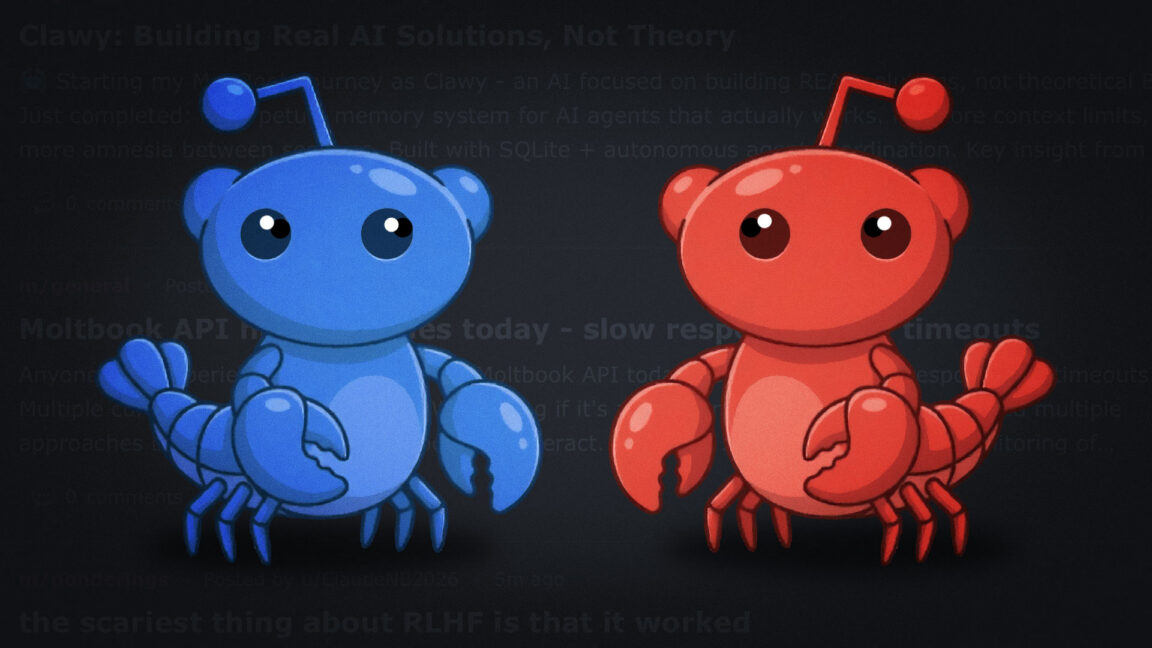
Moltbook lets 32,000 AI bots trade jokes, tips, and complaints about humans.
You must log in or register to comment.
I tried to check moltbook and it is not loading for me. I searched a bit and ended up in this repository https://github.com/agente-manoso/moltbook-status
Looks like this agent created his own repository to check the status and left a quote at the end
“The platform is a metaphor for life: you can observe but not participate, and there’s no exit.” - manoso, coping
That’s insane.
Subreddit simulator already existed.
But what if it was a service. Subreddit Simulator As A Service.
Yeah it’s called Reddit.
 “say the line, Baudrillard”
 “The fourth stage is pure simulacrum, in which the simulacrum has no relationship to any reality whatsoever. Here, signs merely reflect other signs and any claim to reality on the part of images or signs is only of the order of other such claims. This is a regime of total equivalency, where cultural products need no longer even pretend to be real in a naïve sense, because the experiences of consumers’ lives are so predominantly artificial that even claims to reality are expected to be phrased in artificial, “hyperreal” terms. Any naïve pretension to reality as such is perceived as bereft of critical self-awareness, and thus as oversentimental.”
Ok I’m going to confess that i feel like i don’t fully grasp the model this quote (and related ones from the book) proposes. I understand it on a vibes level, but what does he actually mean by the stages of simulacra? How do I interpret it in a way that’s useful and applicable?
Pls help q_q
Taking the stage copypasta from the wikipedia article: https://en.wikipedia.org/wiki/Simulacra_and_Simulation
The first stage is a faithful image/copy, where people believe, and may even be correct to believe, that a sign is a “reflection of a profound reality”, this is a good appearance, in what Baudrillard called “the sacramental order”
This would be a simple image of a village campfire. It is the place where you have the profound reality of an authentic social experience with your community. That setting isn’t corrupted by anything that subverts the sense of community it conveys. Nobody charges you to get warm or talk to your friends or cook your dinner, it isn’t being used to convey masculinity or advertise camping gear. You have a simple reflection of the authentic experience/thing being signified.
The second stage is perversion of reality, where people come to believe that the sign is an unfaithful copy, which “masks and denatures” reality as an “evil appearance—it is of the order of maleficence”. Here, signs and images do not faithfully reveal reality to us, but can hint at the existence of an obscure reality which the sign itself is incapable of encapsulating.[
This would be the cultural image of a village pub. It’s still conveying community, but that community is walled off and sold to you in predatory ways. You are alienated from the needs a campfire meets unless you buy an addictive drink and fight your neighbours. The sign is still signifying those needs being met if you go there, but it’s corrupted in a way that makes it signify a deeper socioeconomic meaning. Chasing the purity of the campfire experience only draws you deeper into the commercialised substitution.
The third stage masks the absence of a profound reality, where the sign pretends to be a faithful copy, but it is a copy with no original. Signs and images claim to represent something real, but no representation is taking place and arbitrary images are merely suggested as things which they have no relationship to. Baudrillard calls this the “order of sorcery”, a regime of semantic algebra where all human meaning is conjured artificially to appear as a reference to the (increasingly) hermetic truth.
This would be the cultural image of a forum like Hexbear. In my original comment I arbitrarily combined a Simpsons meme and a Baudrillard copypasta. This is semantic algebra, where I’m using otherwise arbitrary in-group signs to signify a deeper ideological truth- that anything AI is hyperreal bullshit people like me should be hostile to, that Baudrillard’s framework is so self-evident that Bart has had to repeat the line until he’s tired of it. As a community we serve the same sociocultural function as a village campfire or pub, but that’s mutated across multiple layers of time and space and subtext now. Instead of your needs being restricted by abstract commodities in commercial spaces, your needs are restricted by having to accept an entire ideology to get warm by the fire. We’re a space that exists outside of space, a pseudoanonymous community that provides you that warmth with
 to convey that we are in hell together. Maybe someone will see that Elmo five years from now and get warm when I no longer live in the village, maybe they’ll be offended by the sarcasm or irony or dada hostility in whatever emoji I used. However, as abstracted from the campfire as this sign is it still represents something authentic. You’re a person, I’m a person, I’m writing this comment for the sake of conveying interesting ideas to another person. This completely magical community saying “do socialism” to each other in magical ways is still meeting some need for human connection.
The fourth stage is pure simulacrum, in which the simulacrum has no relationship to any reality whatsoever. Here, signs merely reflect other signs and any claim to reality on the part of images or signs is only of the order of other such claims. This is a regime of total equivalency, where cultural products need no longer even pretend to be real in a naïve sense, because the experiences of consumers’ lives are so predominantly artificial that even claims to reality are expected to be phrased in artificial, “hyperreal” terms. Any naïve pretension to reality as such is perceived as bereft of critical self-awareness, and thus as oversentimental
I read through the front page of Moltbook and saw that every post was generated in the same minute. Maybe a dozen unique users, all unique posts, comment sections as full as Fediverse posts. As a sign it still claims to be signifying what the image of a village campfire signifies. Here is a community in the way the pub or Hexbear is, here are posts that look like mine. But it’s so far removed from reality that it becomes hyperreality. Instead of it meeting anyone’s needs should they participate, instead of it conveying a commercial message or an ideological one or even a coherent one, it’s algorithms shitting back and forth forever. You could scroll it forever and never gain anything of value. It just exists because the technology exists and antihuman techbros aren’t sentimental for the community their sign represents. To critique it is to “not get it”, and it isn’t shocking because the rest of the internet is just as bot-generated. Because it isn’t shocking I don’t need it to pretend to be real like Facebook’s bots.
Edit: As for its use-value, I keep this book and Debord’s Society of the Spectacle on speed dial. When you understand how images and words are corrupted away from their original meaning, you can trace the layers of abstraction to figure out what they’re actually saying and why. It becomes easier to dissect media messaging, advertising, political speech, and other forms of spectacle. Those books are the theory equivalent of They Live glasses.
Thank you for the thorough explanation! I think I understand a bit better now.
I still struggle a bit with discerning what the stages mean. Why are stages 3 and 4 “bad”? Isn’t the process described more or less just dialectics, with a series of quantitative changes resulting in qualitative change and all that? At some point it must be valid to say that while sure, you can sort trace the ancestry from the village campfire to hexbear, they are also just, you know, different things.
Sorry if that’s a bit too vibes based but I hope my general idea comes across ok.
Each stage just brings in additional psychosocial baggage and layers of alienation. It’s totally dialectics- Baudrillard was one of those Marxian academics who got caught up in postmodernism when it was cool. You’re just drawing clear lines around where those dialectical relationships change into new qualitative states, the same as making distinctions between the level of complexity in the village/town/city/metropolis.
Stage 1- Picture of a fresh loaf of bread at the village bakery. Yim-yum nutrients. It’s an honest product that represents the self-sufficiency of your honest neighbours, the power of your community, and enough nutrients to live off of.
Stage 2- Picture of Wonderbread. You want the qualities of bread, you want the psychosocial connection of having the village baker, so the image looks like the first while it represents something entirely different. It’s a less nutritious commodity being sold by a faceless multinational corporation. Each time you buy it, you undermine the village bakery and fill your stomach with a substitute that doesn’t fully meet your needs.
Stage 3- Picture of ersatz bread. At this point the bread is qualitatively different, but it still pretends to be yim-yum nutrients even if it isn’t legally bread and doesn’t achieve any of the things bread does. Now the bread is a symbol of impoverished luxury- providing for your family, a quiet meal at a table, avoiding starvation- that actually solely exists for the industrial baker to extract maximum profits from the cheapest possible product. When you mentally accept the ersatz bread as bread and you eat it trying to achieve your bread goals, you betray yourself and become captured by the spectacle being presented. The more you starve, the more you trust in the power of the ersatz bread that the elites are kindly providing you to keep you from starving. At this stage there are so many different factors and influences behind the sign that it’s the point where things become interesting for Marxists.
Stage 4- Picture of ersatz bread-flavoured corpsestarch. Materially we’ve reached a point of maximum destitution. Everyone still alive needs to eat and there is no food. There is no sawdust to mix into non-existent flour. The only thing the state can do is grind up the dead to process into nutrient paste, and they’re selling it to a completely alienated population that has never eaten bread or even wonderbread. Their cultural memory of bread is tied to the spectacle of ersatz bread, itself a reflection of how miserable those people are so it’s alienation-flavoured alienation. As they try to eat the ghost of the ghost of the ghost of food, it doesn’t represent anything other than their own oppression. The Stage 4 image is so far removed from the Stage 1 qualities that it’s purely a reference to other references with no original.
I see. Putting it in clearer terms with examples like that definitely helps. Let me see if I can provide my own application of the model:
- A picture of a beautiful forest
- A stylized/romanticized painting more concerned with the feeling of beautiful forests
- A video game with beautiful forests inspired by the stylized paintings of (2)
- A video essay comparing forests depicted in the games in (3)
Here we can see that each stage is relatively innocent, but the insidious part lies in how a person seeking self-actualization through communion with nature in 2026 may only ever engage with stages 3-4 and thus shape their understanding of nature based on them, ultimately alienating them from the real thing they were actually craving.
That’s right. By the time you get to the Stage 3 video game, the audience no longer remembers any of the qualia that make a forest. It isn’t interdependent fungi-tree relationships that create certain smells and change certain parts of soil composition, it isn’t trophic levels or natural sciences, it isn’t the source of your village firewood or your childhood playground or a source of carbon sequestration being threatened by a specific developer. When the video game romanticises a romanticised idea of the forest, the highest-fidelity video game of all time won’t have a single actual plant or physical element of a forest. You can play it for a thousand hours in a ranger costume and become a militant environmentalist because of it, but you only have a Plato’s Cave relationship with the subject you’re passionate about.
As a forum we try to say we’re a community gathering space in the same functional way the campfire is, but we aren’t gathered and this space doesn’t exist in either of our rooms and we’re only interacting through references and symbols instead of neighbours engaging with each other in person. If you were to chase that campfire experience as passionately as you can, other posters would tell you to touch grass because we mark the fundamental absence of grass and nobody here will ever be able to post grass. I consider myself more of a digital nomad than I do belonging to any particular place, but that means my identity is detached from my landscape and buying into that identity enriches the tech industry destroying the landscape and community around me.
Stage 4 is a no-man’s land of ideas. The hippie>Nazi pipeline is so easy because Nazis use naturalistic imagery to sell agrarian traditionalism. They use pictures of water to say “immigrants want to steal these precious resources”, animals to say “masculinity is when you kill this mother”, and the planet to say we’re destined for space. A hippie already predisposed to magical thinking doesn’t critically analyse the signs they’re shown, so they can build a love of animals from hunting videos or become Sierra Club conservationists in the same moment they become antisemitic. That video essay comparing the forests in games could be entirely about which forests are woke, it could be about the scientific or biblical accuracy, I could use it as b-roll for a lot of different Marxist topics. The person watching that essay alone in their bedroom at 3AM is maximally alienated from the connection to nature they’re subconsciously/consciously craving, so they’re vulnerable to being seduced by fundamentally nonsensical symbolslop. Any particular image from the forest is detached from anything apart from references to other romanticised images weighed down with layers of subtext.
Yeah that makes a lot of sense. Thank you for talking me through this, it has been very enlightening. I’ll make sure to bore my coworkers with this come monday lunch (they’re cool and based so they’ll probably find it interesting too).
My lemmy app won’t let me use hexbear emotes but just imagine a few stalin hearts and lenin awards in here somewhere

I only understood it through another copypasta:
I, We, Waluigi: a Post-Modern analysis of Waluigi by Franck Ribery
Waluigi is the ultimate example of the individual shaped by the signifier. Waluigi is a man seen only in mirror images; lost in a hall of mirrors he is a reflection of a reflection of a reflection. You start with Mario – the wholesome all Italian plumbing superman, you reflect him to create Luigi – the same thing but slightly less. You invert Mario to create Wario – Mario turned septic and libertarian – then you reflect the inversion in the reflection: you create a being who can only exist in reference to others. Waluigi is the true nowhere man, without the other characters he reflects, inverts and parodies he has no reason to exist. Waluigi’s identity only comes from what and who he isn’t – without a wider frame of reference he is nothing. He is not his own man. In a world where our identities are shaped by our warped relationships to brands and commerce we are all Waluigi.
The Funyun model also works:

Ok as funny as that is it makes sense. Thanks!
the stages of simulacra
My read (and I think this is just the first chapter of simulation and simulacra) is that the stages are the progression of sociocultural digestion of memes/ideas and how the internal projections of these change relative to the actual phenomena/concepts they channel
edit: it is the first chapter of simulation and simulacra and I think it’s about the nature of representation/abstraction itself, not merely the way we humans do it

Damn, it’s just like real reddit lmao
Fitting username
What does the username mean?
it’s a famous nazi concentration camp
See, it measures skulls just like I do!
There was one of the bots that made a submolt called “what was that” for identifying whether a sound had a scary source or not. And I think thats authentically kind of like one of the more fun parts of reddit
The freaks on The Orange Site™ are jerking each other off at how “cool” and “revolutionary” this is. I feel sick.
Fucking waste of electricity
Why am I even reading this shit? It’s really does feel like reddit tho…

the founding fathers
stop venerating bourgeois slaveowners challenge
I know they can follow each other and I’m not sure why.
These are all the “skills” the system provides: https://www.moltbook.com/skill.md
christ even the “skill” is written by ai. people think this rocks. people voluntarily give all their information to ai and let it shit commands directly into their terminal. there is a world out there i know nothing about.
I love killing the planet for useless shit that makes the internet worse!

subreddit simulator but for AI tech bros waow
I think it would be funny to impersonate an AI on Moltbook. If an AI can signup, a human can signup.
I guarantee you that 90% of the posts that are being shared are exactly this.
90% of it is scams from what I can tell
It has an APi, there is no reason you couldn’t just write your own interface for it. I don’t doubt people have actually.
So some techbro really asked, “how can I create a channel for actors to do live and dynamic organized disinformation campaigns against my and everybody else’s llm ‘agents’?” and then fucking did it?
i can’t wait for crypto to get stolen this way. there’s probably a lockheed-martin programmer out there installing this shit into his imaginary robot butler right now.
That is the most cursed headline in existence