
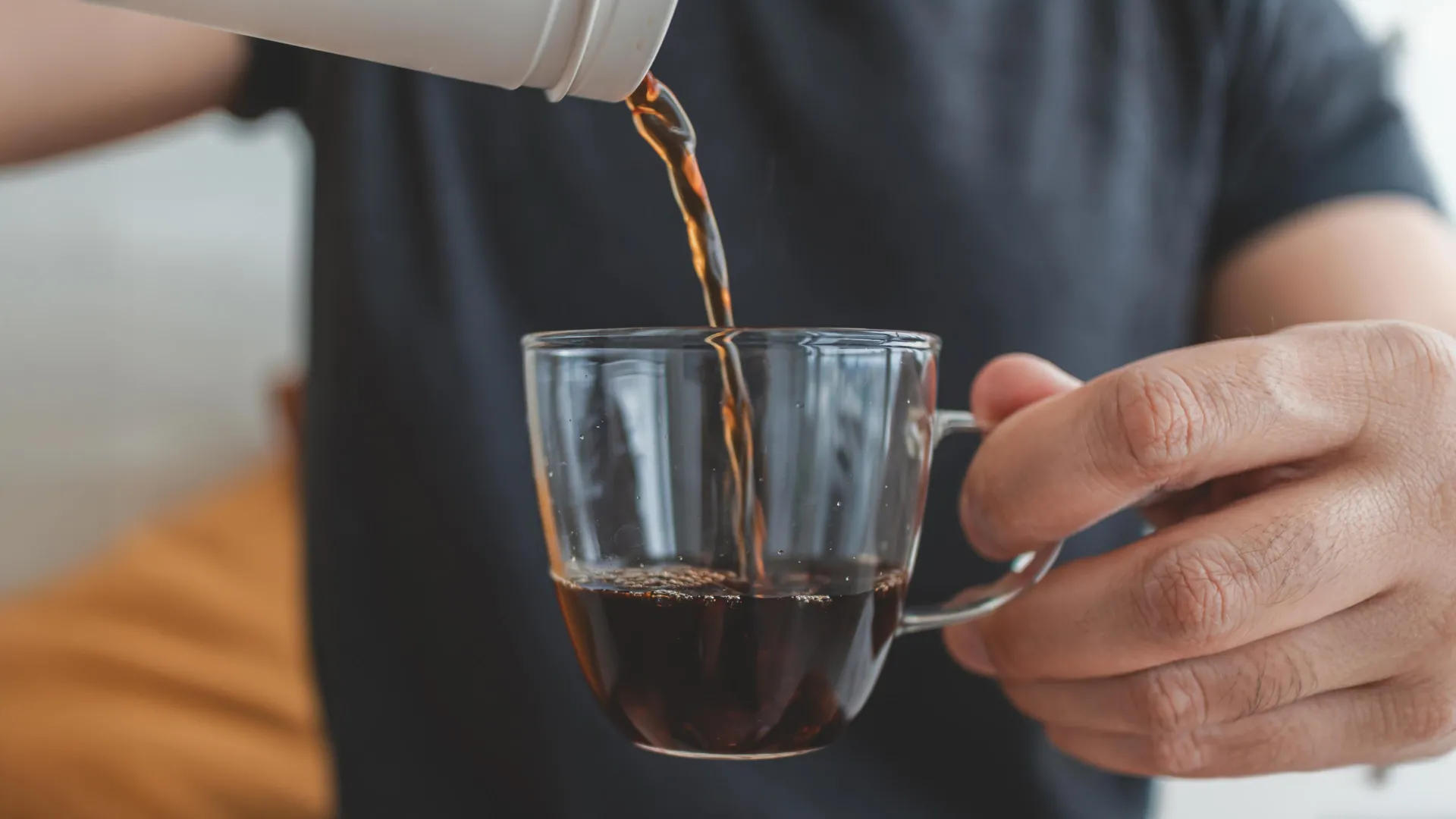
Correlation, likely not causation. Lifestyle, etc.
Personally I’d believe that there is a strong correlation between healthy/reasonable living, and coffee consumption. White collar workers suffer less physical strain, and coffee consumption seems to offset sugary drink consumption (something about coffee reducing appetite perhaps?)
Caffeine is common to both.
What I want to know is, how much cream and sugar can you add before it cancels out the positive effects?
Well, that depends on context. If you are drinking coffee before going to the gym adding sugar would even increase it’s positive effects (although complex carbs like cluster dextrin would of course be preferable over sugar)
You do you, but if you feel like you need to add additives to your coffee to make it palatable, might I suggest finding a better quality coffee.
Can you also fund the better coffee? Because that shit is expensive.
I have switched to putting caffeine and theanine in water in the morning, then adding flavour and carbonating. Crisp, refreshing, hydrating energy drink, for pennies. Recommend.
I was trying to find out why caffeine anhydrous is so much cheaper per serving than a cup of coffee or tea when the source is coffee or tea. My only conclusion is they must use un-saleable types of coffee beans and tea leaves for caffeine extraction. Anyway, DIY energy drinks are stupendous, I can’t countenance paying so much for a can. What’s your preferred carbonation method, a Soda Stream or similar?
un-saleable types of coffee beans and tea leaves
In fact, that’s natural caffeine since it comes from the bean or leaf; I use synthetic, which is derived by reacting urea and chloroacetic acid into barbituric acid, from there into theophylline by reacting with dimethylurea and formaldehyde, and finally methylated to get something chemically almost identical to pure caffeine:
- https://ific.org/insights/natural-vs-added-caffeine-whats-the-difference/
- https://properwild.com/blogs/blog/how-is-caffeine-made-artificial-vs-natural
I started with the synthetic because I wanted to observe the effects alone, and with l-theanine added; I didn’t want other compounds along for the ride and polluting my results. Natural is much more expensive, too; I find synthetic plus theanine sufficient. For carbon dioxide refills, there’s a guy in my area who exchanges the gas bottles and refills them himself. You could see if you have anyone like that nearby, or, often paintball shops and sports shops that sells paintball gear will be able to refill your cannisters for you.
Carbonator is a “drink mate” - unique from sodastream in that it can carbonate other liquids, not just water, without messing up the mechanism. Of course, I pretty much only carbonate water with it anyway… I’m certainly not gonna try it with milk! (jokes aside I have done juice, that was pretty cool)
You’re right, and unfortunately it’s also difficult to find a good quality coffee that’s Fair Trade too.
Theanine? What’s that do?
Indeed… Sounds like an unfilled niche, when you put it all together like that 🤔
Anyhoo. l-Theanine is one of the active ingredients in various teas, alongside caffeine, and complements the effects of caffeine while also offering neuroprotective effects. You’ll find it in coffee too, but only in trace amounts, where in tea it’s a lot closer to 1:1 (variable by botanical of course). Some light reading I happened across in my excursions:
- The Cognitive-Enhancing Outcomes of Caffeine and L-theanine: A Systematic Review: https://www.ncbi.nlm.nih.gov/pmc/articles/PMC8794723/
- Effects of l-Theanine on Cognitive Function in Middle-Aged and Older Subjects: A Randomized Placebo-Controlled Study: https://www.ncbi.nlm.nih.gov/pmc/articles/PMC8080935/
- l-Theanine and caffeine improve target-specific attention to visual stimuli by decreasing mind wandering: a human functional magnetic resonance imaging study: https://www.sciencedirect.com/science/article/abs/pii/S0271531717304967
- Effect of single or combined caffeine and L-Theanine supplementation on shooting and cognitive performance in elite curling athletes: a double-blind, placebo-controlled study: https://www.ncbi.nlm.nih.gov/pmc/articles/PMC10566444/
- Effects of l-theanine-caffeine combination on sustained attention and inhibitory control among children with ADHD: a proof-of-concept neuroimaging RCT: https://www.ncbi.nlm.nih.gov/pmc/articles/PMC7403383/
And, this is a very long-term study - it’s more about the other compounds in coffee and tea than the caffeine and theanine, but it’s a good read and at least tangential to your question: https://pubmed.ncbi.nlm.nih.gov/39772974/
There’s also this meta-study I found while I was looking for the first one, which shows the benefits differ somewhat based on physiology: https://pubmed.ncbi.nlm.nih.gov/37523229/
I hope that answers the question 😂
Damn. That is the best response I could have asked for. Thanks!
Just FYI: all those studies are poorly controlled, underpowered and typical of the junk science around supplements.
Fair cop on some of it, but some I will defend, and the wider point holds. At supplement doses theanine alone has a narrow but consistent effect on reaction time; paired with caffeine it does more, across attention more broadly. Moderate effects, not miracle ones, but they replicate across independent meta-analyses, which is more than most of the supplement aisle can say.
Binning, and cheerfully:
- The Cureus systematic review: https://www.ncbi.nlm.nih.gov/pmc/articles/PMC8794723/ - this one’s genuinely poor and including it was laziness on my part. PubMed-only search, five studies included, three of them from the same lab. Its methods section claims it extracted Modified Rankin Scale, NIHSS and Barthel Index scores, none of which appear anywhere in the paper. That’s leftover boilerplate from a stroke-review template that peer review didn’t catch.
- The fMRI one: https://www.sciencedirect.com/science/article/abs/pii/S0271531717304967 - n=9, males only, and the paper says outright it was underpowered for the BOLD analysis.
- The ADHD one: https://www.ncbi.nlm.nih.gov/pmc/articles/PMC7403383/ - n=5, single-blind. Honest about being proof-of-concept, but reporting p=0.080 as an “improvement” is soft.
- Baba: https://www.ncbi.nlm.nih.gov/pmc/articles/PMC8080935/ - five of six authors work for ITO EN, who also funded it. Not fraud, but it’s ingredient-maker research with a big test battery and a scatter of significant sub-tests.
And two of mine, while I’m at it:
- The 1:1 ratio was wrong, I misremembered. The actual tea arms in the meta-analysis below come in at 46 mg theanine to 100 mg caffeine, 67 to 136, 17.5 to 87. So 1:2 to 1:5 depending on the leaf (variable by botanical, as I said).
- “Neuroprotective” was an overclaim. That traces to rodent focal ischaemia models: https://pubmed.ncbi.nlm.nih.gov/17928735/ - not human data.
Not binning:
Those links were what I’d happened across, not a curated evidence base, and I never claimed the list was exhaustive. A weak cite doesn’t kill a claim, it just means I grabbed badly off the shelf. The claims themselves hold up in much better-conducted work:
- Cognitive and affective effects of L-Theanine: a systematic review and meta-analysis of 31 randomized trials (Mol Psychiatry, 2026, n=1168): https://www.nature.com/articles/s41380-026-03727-9 - single 200 mg dose, 30 to 60 min before testing, improved choice reaction time, SMD 0.51 (95% CI 0.25 to 0.77). No serious adverse events across the lot. Caveat: senior author founded a supplement company.
- Effects of Tea or its Bioactive Compounds l-Theanine or l-Theanine plus Caffeine on Cognition, Sleep and Mood (Nutrition Reviews, 2025, 49 RCTs, 15 pooled): https://academic.oup.com/nutritionreviews/article/83/10/1873/8123998 - theanine alone improves choice reaction time (SMD -0.35, CI -0.61 to -0.10, about 18 ms) and does close to nothing on simple reaction time, digit vigilance or accuracy. The combination with caffeine is where the wider effects are: attention switching accuracy SMD 0.40 (0.24 to 0.57) in the first hour, digit vigilance accuracy 0.20 (0.02 to 0.38) in the second. Caveat: two of five authors are Lipton Teas and Unilever, and admittedly the industry was the single most common funding source across the included trials. Though, that doesn’t invalidate anything on its own, either.
- Acute effects of tea constituents L-theanine, caffeine and EGCG on cognitive function and mood (Nutr Rev, 2014): https://pubmed.ncbi.nlm.nih.gov/24946991/ - the original combination meta-analysis, moderate effects on alertness and attention switching in the first two hours.
Also, “underpowered” is the wrong stick for two. The Saku cohort (https://pubmed.ncbi.nlm.nih.gov/39772974/) is 1155 people followed about fifteen years, and Zhu 2024 (https://pubmed.ncbi.nlm.nih.gov/37523229/) pools 33 studies and 389,505 participants. Their weakness is that they’re observational: food frequency questionnaires, healthy-user confounding, and pooling observational studies pools the confounding rather than cancelling it. Real problem, different problem, and I’d rather be criticised for the one I’ve actually got thank you very much.
The curling study (https://www.ncbi.nlm.nih.gov/pmc/articles/PMC10566444/) is n=22 but crossover, which brings more power per subject than the raw number suggests. Narrow population and sports nutrition has a publication bias issue, but it isn’t junk.
So. The acute attention effects at supplement doses are real, hold up across independent meta-analyses, and are stronger with caffeine than without. Sleep and relaxation effects are not as concrete as the marketing suggests. Neuroprotection is rodent focal-ischaemia models, and that class of result translates to humans badly (if there’s human evidence I haven’t found it). Worth being clear as well that the cohorts above don’t necessarily fill that gap: they measure tea and coffee drinking, not theanine intake, so anything they find could be catechins, chlorogenic acids, the sort of person who drinks green tea, etc.
It’s in tea. Its added to energy drinks cause it helps with the caffeine jitters. It helps smooth things out so you don’t feel like you’re having a panic attack like pre workout does to some ppl.
A quality 2 lb bag from a well respected roaster that ethically sources their coffee is $37 and is pre ground so you don’t even need to buy a grinder. It will make approximately 64 8-oz cups of coffee. That is less than 60 cents a cup.
What are you talking about, expensive?
If you want a recommendation, I love Mad Priest Coffee roasters based out of Tennessee and ship at a decent price.
I’ve always found that pre-ground coffee dries out faster than whole bean and loses some of the aromatics. I’m really surprised to hear it recommended, but I’m glad you’ve found one you enjoy. I’ll keep that name in my pocket to try, in case I decide to go back to coffee.
Good question. No cream is better:
Most People Ruin the Health Benefits of Coffee (and Tea) Without Realizing It - There’s an Easy Fix

someone better tell my fat ass, because it clearly didn’t get the memo.
I gotchu homie
Put me on speaker
Does it matter if the coffee is decaf or caf?
Surprisingly there is a inverse relationship in dementia risk. Normal coffe has lower and Decaffeinated has a slightly higher risk. Source
The meaning of life: 42 and ☕️
Coffee needs to be only hot, only caffeinated, and only black. Otherwise it’s not coffee, it’s dessert for breakfast.
I like it black, but I can’t have that much caffeine so I mostly have to drink decaf. If you don’t like your regular as decaf try others as removing it changes the taste.
Huh maybe that explains my aversion to decaf. I will absolutely drink it in a pinch but my go-to coffee offers a decaf version and I can confirm it does not taste the same (or very good).
boil the grounds on the stove at that point if you like pain
“Cowboy coffee” I’ve done this. It does work.
Cowboy coffee is roasting green beans in a skillet, then making coffee in a percolator. It’s brown and has massive amounts of caffeine. Tastes like shit.
Dessert for breakfast is a proud American tradition.
I am not saying it is a good American tradition. But Americans are very proud of “cereal” like Captain Crunch, and that one which is just little chocolate chip cookies.
You’re thinking of cookie crisp
Yeah I am!
Cookie crisp?
That’s the one 😁
Breakfast foods in the pancakes family are straight up dessert. I love pancakes but I have them for breakfast once every couple months or so.
And don’t get me started on cinnamon rolls.
You’ll get downvoted by people who cause lineups a coffee shops while they order warm Dairy Queen sundae they call coffee.
And people who just make cold brew. Tastes much better than the horribly bitter espressos coffee snobs pride themselves on.
Eh that’s how it goes. My coffee does not intersect with any of that.
I tried to get a small coffee from 7brew (drive through coffee) the other day and I’m not sure you CAN get just a cup of coffee there. I ended up just driving back out.
I’m not standing around because people need to feel momentarily empowered with a custom order for a hot dessert.
This is why I love Italy, that bullshit is not tolerated.
Is this why they’re so fucking unbearable? Hopefully with this research we can cure them.
This just in: drinking coffee makes your dick harder and tits perkier.
Nah but really though I think they design these studies to justify their own relationship to caffiene.
Coffee is the only way I take in water! Other than that I might drink 2 or 3 bottles a year.
Preservation through dehydration.
I can’t stand water by itself. I’m old and retired and it’s worked out so far.