- cross-posted to:
- chapotraphouse@hexbear.net

- cross-posted to:
- chapotraphouse@hexbear.net
You must log in or register to comment.
Not surprising since we already have studies that show microplastics get released in things like plastic containers when used in the microwave that’s caused due to heat but still good to know and be informed even if I don’t use them outside of very occasionally.
So do microplastics harm our bodies? I can’t think it’ll help, just wanna know the severity to be worried lol
We don’t really know yet. Seems like there are assloads of studies finding plastic in places plastic probably shouldn’t be, and literally none of whether or not this is actually bad or how bad it is.
There is also assloads of corrections finding that some of those studies were bust because of sample contamination during the study. It’s almost impossible to not have microplastics everywhere including your research instruments. Which you’d think will be an evidence by itself, but we really can’t tell anything.
Microplastics might be overblown because scientists didn’t realize their gloves release particles that look like microplastics but aren’t.
https://pubmed.ncbi.nlm.nih.gov/36948312/
and
https://dceg.cancer.gov/news-events/news/2025/tgct-hispanic-men
No link has been found between the two of course but does make you go hmmmm…
It is already annoying, let’s just get this over and simply say if it is made of plastic, even in small part , it will release micro plastics .
Because every other day is another “revelation” of something obvious .
Even the paper fast food cups have a plastic liner, which isn’t obvious unless you examine it or look into it. It’s insane.
How else would paper hold a liquid
Back in my day, they used to use waxed paper.
:: disintegrates into dust and blows away ::
This is clearly one of those: no fucking shit situations
Who the fuck sips hot beverages literally from plastic is not aware or considering the consequences.
Tf is wrong with most people.
People see a paper cup and dont think about how they make it waterproof
I thought it was wax, not plastic. The lid is plastic though.
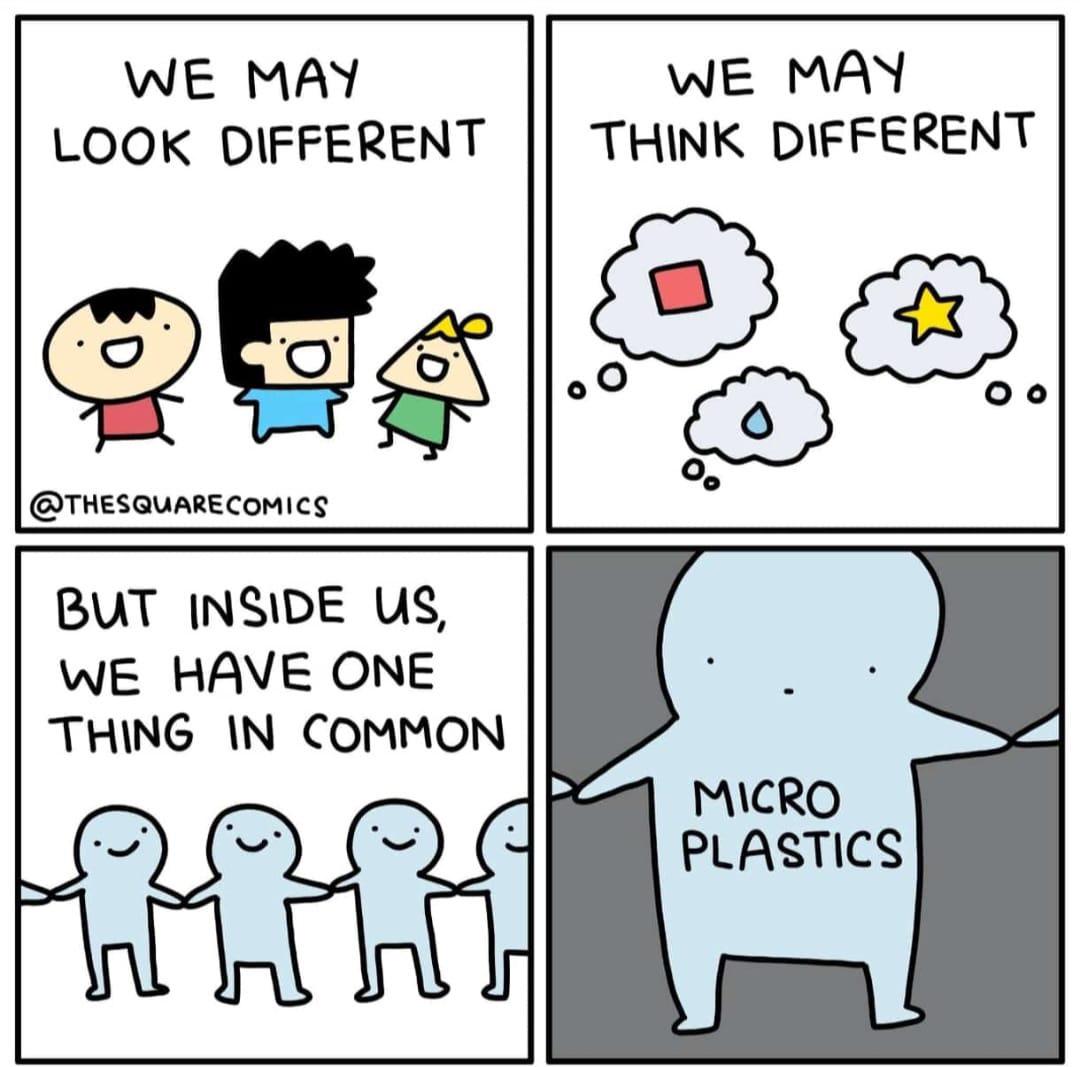
I kinda figured that was the case.
The coffee and cream also contain micro plastics.
The coffee is also cursed
That’s bad
But you get your choice of topping!
That’s good
The toppings contain potassium benzoate
…
That’s bad
I’m getting macroplastic sprinkles
I’m still a little mad society didn’t latch onto “frogurt” instead of “froyo”.
Like a fun curse? A low poly skull follows you around and goes MYEH now and then?
You may call me MURRAY!
Ah I forgot about Murray! I was actually referencing a tiny indie game called Diaries of a Spaceport Janitor though
And I pissed in it
It’s microplastics all the way down.
Just add it to road tires sloughing it by driving… It’s the new leaded disaster. Thanks oil lobbies.
Lead is still a disaster though. Fazing lead pipes out is great but with out subsidies for remediation old lead pipes never get removed. Places like France didn’t even faze our lead pipes until 1995
Lead pipes are safe while they’re stable. If they get moved or cut or anything, or acid removes the protective layer, then they can become unsafe. Kind of like asbestos.
Lead in avgas, on the other hand, is definitely unsafe.
That’s okay, all the individual ingredients are already riddled with micro-plastics, and so are we
I think at this point the environment is so infused with them that it is pointless to pretend we can avoid them.
I remember one study about microplastics gave up because either they couldn’t find an uncontaminated control, or their measuring equipment was contaminating it. I’m not sure if they could tell which one it was.
Oh yeah? Well I’m releasing micro-me’s into takeaway cups. Take that, microplastics industry!
Given that cops on TV routinely use them for DNA, you’re absolutely right.
How I imagine you doing this -

“Here, one with extra micro-plastic”

Man, these university researchers just love telling us all the ways we’re gonna contract some horrible condition, or disease, or death.
On the other hand, there are probably more carcinogens in city air than microplastic.
There’s microplastic in the air.
they don’t love telling you that.
the media loves telling you that, and loves making rich white peopel panic and go out and buy all new cups/cookware/appliances based on the new latest scary study.
and i have relatives who do this. every 5 years they re-buy everything in their kitchen based on whatever is the latest scare trend is. non-stick, plastics, pfas, bpa, etc. it’s like clockowrk, every 5 years there is a new boogeyman think that you have to go buy all new pots and pants and dishware to ‘avoid’. or water bottles.
i bet in 5 years we’re going to start hearing how eating of out steel cookware/cups is bad for you and we all have to go back to plastic because that’s safer.
All that micro rust accumulating in your bones!
Most coffee drinkers are addicts.
If you’re an addict, I see no reason why you wouldn’t bring your own steel double wall vacuum mug.
I do actually, but by the time I’ve transferred it, the damage is done. Baristas have told me they have to put it in disposable cup rather than using mine.
Boycott those stores.
Decent coffee shops offer a discount if you bring a reusable mug, because it saves them a disposable one.
A disposable coffee cup costs cents. They throw out far more than that in unsold food at the end of the day. It’s not really about the cost of the cup.
They throw out far more than that in unsold food at the end of the day.
Again, if the store is wasting food, boycott it (or persuade it to stop doing so).
Decent coffee shops partner with local homeless shelters, or food apps / messageboards (Olio, Too Good To Go, …), to find takers for their leftovers.
It’s not really about the cost of the cup.
Indeed, which is why I did not say that it was “really about the cost of the cup”. The latter is, as you correctly imply, only one factor.
Find a better café? Most places offer you a discount when you bring your own cup
But before that, the processing of the various things put in the cups adds microplastics too.
I’d have to think you’re right about this. Plastic is so versatile, I’ll bet it’s all over any sort of food processing.
Yeah, I’ve been assuming that plastic isn’t something I want anywhere near my food but can only really control plastic contact with my food inside my place. Most comes packaged in plastic. I think glass jars and produce/things produced in the store are the only things that don’t automatically come in contact with plastic, though in practice it’s only the glass jars that continue to avoid it because the stores provide plastic packaging for produce and their other stuff like meat/deli cuts or baked goods.
And I’d be surprised if the contents inside the glass jars aren’t typically stored in plastic between the farm and the jarring plant, though at least there the bins are likely large enough that contact is minimal for anything not at the edges.
You’re right. But, it’s less about the storage, and more about the processing. The machines used to process food all have plastic parts, bearing surfaces that wear down.

Studies published in Food Chemistry found microplastics in every commercial olive oil they tested — so olive oil does have microplastics, and the plastic comes from the extraction and bottling chain, not the olives. A 2024 study of olive and vegetable oils from Italy and Spain measured a mean of about 1,140 particles per liter, mostly fragments under 100 microns and dominated by polyethylene and polypropylene — and found no significant difference between oils bottled in glass and in plastic.
At least PE and PP are relatively harmless. I think the narrative than any microplastic is bad covers up the evil that was polluting our world with PFAS.
One study found that stuff in glass jars actually had more microplastics than stuff in plastic bottles, from the paint on the lid.
But not the paper one’s, right
Edit: if the paper cup is lined with PLA or PE, yes.
Every disposable food and drink container made of paper is lined with PFAS.
Fortunately that’s absolutely not true. You can buy plastic free paper for wraps and burgers.
Also, wax paper has been a thing long before plastics.
Fortunately that’s absolutely not true. You can buy plastic free paper for wraps and burgers.
PFAS are not plastics.
Also, wax paper has been a thing long before plastics.
Yes, this is true. In my experience I have had a very difficult time finding it and no restaurant where I live uses it anymore. I can’t speak for the rest of the world.
Any “paper” food container is lined with plastic. Grease barrier, water barrier, etc.
Fortunately that’s absolutely not true. You can buy plastic free paper for wraps and burgers.
Also, wax paper has been a thing long before plastics.
They use to make wax coated paper cups which was a step better. Also used to wrap candy in paper instead of plastic sleeves. Oh and all soda came in glass.
The heat of the coffee melts the wax, which kinda ruins both the coffee and the waterproofing-functionality.
Wax is great! Sadly most wax nowadays is made of oil.
…what do you think is the difference between wax and plastic…?
Wax biodegrades easily and breaks down in compost environments and doesn’t accumulate in your body…?
So in the context of packaging none of that is true. The real difference between wax and plastic is that plastic has a higher molecular weight. No specific cutoff, it’s mostly just vibes. Some packaging folk add a second criteria: wax melts, then burns, while plastic just burns.
Using your definition of wax, you’re pretty much living in the 17th century. Nowadays, wax comes from oil, and is usually the exact same polymer as the plastic packaging on the next product over. But with slightly smaller molecules.
Edit: I forgot grease barrier. Old school compostable biodegradable wax dissolves in grease. You don’t want that.
No, sorry, that’s an elementary misunderstanding of molecular weight.
Saying plastic and wax are the same because plastic just has a higher molecular weight is like saying a puddle and a glacier are the same because they’re both water. Molecular weight dictates how a material behaves. Plastic’s massive polymer chains (up to millions in molecular weight) cannot biodegrade, they break down mechanically into toxic microplastics that persist for centuries. Waxes are short-chain molecules (molecular weight under 1,000) that do not fragment into microplastics.
Furthermore, you’re assuming all wax is petroleum-paraffin. The push for wax packaging today relies heavily on natural, bio-based waxes (beeswax, soy, plant waxes), which are structurally chemical esters, not petroleum polymers. They are fully compostable, safe, and easily processed by the environment and living organisms. It’s not ‘vibes,’ it’s basic chemistry.
Okay. And then what happens when your <1000 mw wax polymerizes into a surface coating?
Because if I take 10 trillion cups of water and freeze them all into one block, that’s a damn good approximation of a glacier.