
You must log in or register to comment.
unrelated but I saw a video where a guy used a slingshot to lob an incendiary almost 300 meters
Can you send it to me for science
Link or lib
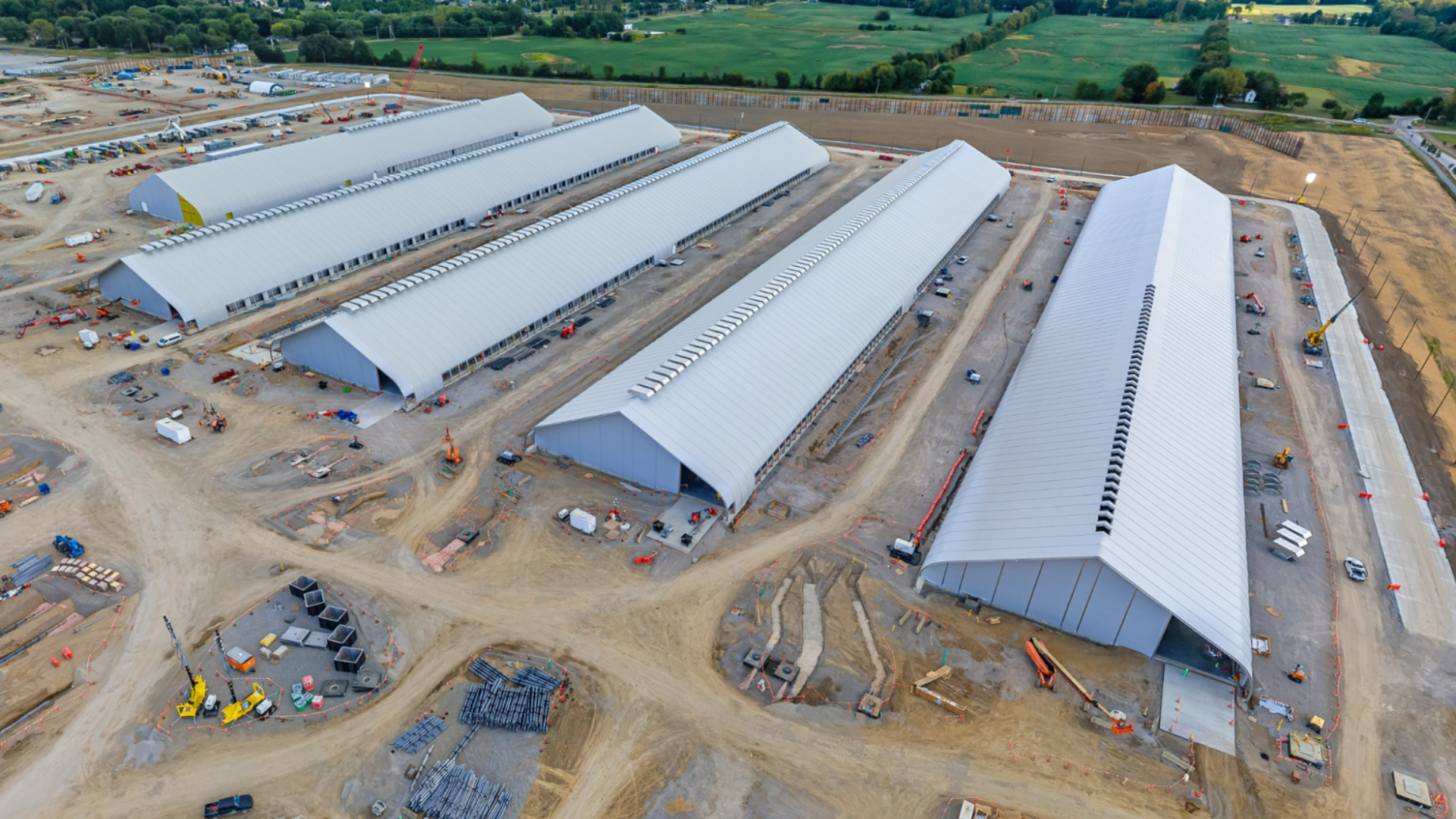
Free servers. Bring your own forklift.
Many rural communities pushed back on wind power due to noise. Can’t imagine living near an always on jet engine
Meta’s turbines would be a permanent feature on the Ohio site, as it’s designed to run independently of the power grid. […] Putting AI servers inside tents, officially called “rapid deployment structures,” is one of the more unique approaches to the AI build-out, Thomas said. They’re certainly not as sturdy as physical buildings made from steel and concrete, with one commenter comparing it to the “classic $10k racing bike with a $9 lock” situation.
$10k racing bike with a $9 lock


GPUs love sand
They are silicon
ashes to ashes and sand to sand
Melting spoons in backyard furnaces to produce more steel than ever before.
AI Hoovervilles
concentrated AI feeding operation
Ready for the news of a strong gust of wind absolutely suffocating and destroying the servers
Their rotten stinky makeshift homes.
Our noble and warming data tent cities.
US citizens need to relearn the lost art of building trebuchets from locally available material.
comrade downpour do your thing!
Comrade tornado go gettem 🌪️


this is truly such a stupid fucking bubble. I also hate Mark Zuckerberg so fucking much.
Jet engines
We should take the engines, bolt them all to the ground pointing the same direction, and turn them on all at once to see if we can make the earth turn faster. Sorta like the fireworks that spin and launch themselves into the sky, but with the earth instead.
Before anyone says it’ll fuck the planet up I’d argue we are doing a pretty good job at that as it is. What can it hurt?
Also, I can help but wonder what those jet engines powering up does to the neighboring homes gas pressure? I’ll bet when they fire up it snuffs out pilot lights and burners all over the shared system. They aren’t generating their own fuel so it’s coming from somewhere. Maybe at a midstream processor somewhere before it gets to there. I’d like to see an intrastate gas network map and compare it to where this place sits because those things probably draw several hundred million BTUs if not a billion. It makes me really wonder at the infrastructure needed to handle it all and how much of a burden it places on residents nearby.
If we make the earth turn faster, does that count as time travel?
Lmao imagining the end of JoJo: Stone Ocean but with jet engines instead of the time stand.
Technically it does. If the Earth spins faster we would be moving faster relative to the rest of the universe, so due to relativity time would pass very slightly slower for us (like nanoseconds over the course of a year or something). From our perspective would be moving into the future at an imperceptibly faster rate.
And then getting killed by a… weather report
Also, I can help but wonder what those jet engines powering up does to the neighboring homes gas pressure? I’ll bet when they fire up it snuffs out pilot lights and burners all over the shared system. They aren’t generating their own fuel so it’s coming from somewhere. Maybe at a midstream processor somewhere before it gets to there. I’d like to see an intrastate gas network map and compare it to where this place sits because those things probably draw several hundred million BTUs if not a billion. It makes me really wonder at the infrastructure needed to handle it all and how much of a burden it places on residents nearby.
I don’t know the technical aspects of gas lines but I think there are some sort of regulator valves and sections that hold gas to prevent that sort of disruption. But I’m sure they’re doing some wild shit the pipes aren’t intended to account for.
That’s why I’m wondering about tying in to a midstream processor at a pump station somewhere. I’m not sure if you’re familiar w how natural gas is sent everywhere, but in as few words as possible, gas is produced at the well site, captured, cleaned up, and then injected into a very large gas pipeline at 1,000psi. It is then pumped along interstate and intrastate underground lines at high pressure. Every so often a midstream processor takes the gas, repressurizes it and sends it further downstream. That gets pushed to city/town/local jurisdiction, then stepped down to industrial pressures ranging from 10psi to several hundred psi depending on who uses it.
If they are at ‘district pressure’ Which is maybe 10-50 psi, then they are sharing a branch line with others in said district. Check valves are certainly in place but depending on layout they could be sharing with other industrial users. Or, if they need higher than what the local jurisdiction can provide they might be tapped into a midstream line, and have their own regulating equipment to step it down to whatever is needed. Or maybe they are on their own dedicated propane battery. Propane is more combustible than NG so it’s possible they’re using propane.
I really am curious from a technical standpoint how it was done. I’d enjoy roaming around and looking at the gas equipment.
Bolt them all to the ground pointing upand then solve global warming by turning on the jet engines only at specific times of the day to move the Earth further from the Sun.
deleted by creator
The exhaust in that episode of Futurama does actually go out of the atmosphere! Doh!

What does meta even have to show for their AI investment? The only thing is llama which was used as a launchpad for the Chinese open models
They’ll probably end up running Chinese models on their infrastructure now, the circle of life. 🤣