it’s funny because nobody ever mentions how much of a bitch it was to plug in AT ports without pulling the whole unit out.
“You’d always stick it in wrong at least once, preferably twice, and then swear about it under your breath, as was the style at that time. And the smaller devices had the micro USB ports that had the same problem. And you’d have to take out your mouse’s ball and gently clean all the lint off it when it would start getting all onery. And don’t even get me started about when they removed all the audio jacks from all the cellular phones!”
Grandpa, What’s an audio jack? Is that what you guys used to eat those tide pod things?
Can’t you see that gramp’s busy cleaning his ornery balls
Was it mini or micro usb, tho?
Mini was okay, micro was awful
The pain of those clips
 breaking so fucking often 😭
huh really? i’m using micro 5pin on my daily driver phone for more than a decade now and my stock cable from 2013 still works perfectly
I’ve had them break, but nowhere near as often as people online claim. Maybe I’ve just been lucky.
I’ve also has USB C break down on me already, so…
USB-B always getting forgotten
Unless you’re an office worker or musician
USB micro 3 was the weirdest. One of my Samsunk Note phones used it.
Neat thing a lot of people didn’t know about it though was that you could still plug an older Micro B in and leave the rest unplugged, so it was backwards compatible for things like charging and slow data transfer.
I also have a widescreen conferencing monitor at work with a USB3-B connector for its built-in camera. It also has Type C, but I guess they wanted to give options for people with computers that didn’t have Thunderbolt ports or were using older docking stations.
I have an old Samsung tablet with a USB micro 3, gathering dust in a drawer somewhere. Galaxy tab 2 or 3 maybe? It’s the only device I’ve ever seen with it. I actually find it curious we didn’t see the standard more, as it’s backwards-compatible with regular micro-USB in a pinch.
Yes.
I actually miss having to clean the mouse’s ball. It was oddly therapeutic.
Nah give me lasers, but it was fun to spin as a fidget toy
Ornery vs Onery. They are both valid.
I’ll make and sell USBC cables that only have pins on one side of the connectors, marketing them as retro nostalgic.
I will not be marking them differently from your other cables, for authenticity of the experience.
Replace half the cables from all of your friends’ cables drawers without them knowing and go enjoy your free ticket to hell
wouldn’t that actually be completely fine since the ports handle the orientation?
Honestly, I would like an L-shaped USB standard. It would make it so much easier to figure out what orientation things should go. I have a super-tower PC, and there isn’t enough ambient light behind it for me to easily identify where to stick my USB peripherals.
I am pretty much just blindly stabbing, hoping to connect. 😣

One day USB-A will be so uncommon
Every USB-C to C connector I’ve seen ends up coming with half a dozen adapters, because cell phones seem like the only device that uses it reliably.
Usb-c covers so much that something like 75% of the onea i have are entirely useless for data transfer, or dont have fast charging capabilities, or just… Suck? And sometimes i do feel the need to flip them for troubleshooting purposes or whatever.
I also had a laptop charger that needed to be flipped one specific way. Usb-C will one day die and be replaced with an extremly expensive usb-Delta that everything i wanted but also costs a bajillion dollars
The relevant part of a long rant I once did was, a USB cable that does everything a USB-C to C cable can do has like 19 wires in it, it’s thick, stiff, and expensive. It wouldn’t make those sharp turns from the wall wart up to the night stand for charging your phone. Which is why a lot of the USB-C cables on the market carry USB 2.0 signals. A lot of the population has never used a USB cable to transfer data, it’s a power standard to them.
And manufacturers don’t do a great job of expressing in listings or on the product itself what a cable is capable of. The charging cable that came with my Galaxy phone and the CableMatters 10Gbit/s cable look interchangeable in every way except girth; there’s no markings on the CableMatters cable as to max rated bandwidth or thunderbolt capacity or power throughput. But it’s got their logo on it twice.
USB-A was a rare case of a quantum-locked consumer device. It would not reveal its orientation until after observing all possible combinations.
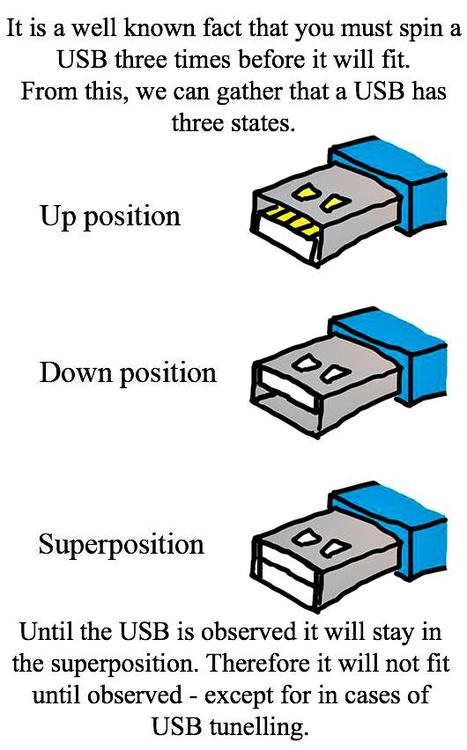
There are quantum objects that need to be rotated 720 degrees to return to their starting orientation. 360 degrees is not enough to get back to the start.
That’s what USB-A is like.
Turn 3 times to achieve the superposition.
One day, children will ask why we don’t make the plugs different shapes so you know if you’re using a 60 watt cable or a 240 watt cable or something in between.
(I do not know anything about electricity so I’m certain there’s a better way to explain this but it’s bananas I have USB cables that look identical but my Steam Deck will die while plugged in if I grab the wrong one)
That’s because your supposed to use usb 3.2-1v3.1.2-hyperfast and not USB 3.2-1v3.1.2-superfast.
The 90’s were even more lead-addled than that. You remember these things:

Barrel jacks and plugs. Typically used for DC power, and that’s all I can reliably say. The socket had an inner pin and and outer ring that engaged with the inner and outer surfaces of the plug. Which was positive and which was negative? BOTH! A given power brick or device could be wired either way, which is why most of them had one of these diagrams printed on them somewhere:

There was no attempt at standardizing sizes or lengths for different polarities or voltages. It was entirely possible you could own a 12V center positive power brick that would plug straight into a 6V center negative device. If you were lucky, the device had reverse current protection, maybe a self-resetting fuse. Some didn’t. Or, somehow worse, you’d find a brick with the right voltage and polarity that wouldn’t physically fit.
So the current state of USB-C charging is considerably less lead-brained than what I grew up with.
deleted by creator
The barrel pin system could have been great if it was standardized. Only one valid polarity with barrel size being keyed to voltage while pin size was keyed to amperage, for example. A plug would only fit if it was the correct specs, and would always fit if it was the correct specs. Unfortunately, nobody ever had this idea while they were popular and it’s much too late now.
I’ve got two devices (An auto-darkening welding hood, and a LED desk lamp) with USB-C ports that will simply not charge if you plug them into a USB-C charger. You cannot use a USB-C charger to charge these USB-C devices.
You must use a USB-A charger with a USB-A-to-USB-C cable to charge these devices.
The way USB-C is supposed to work is the charger, device, and the cable itself have smarts in them, and they all negotiate taking into account the kind of power the device accepts, the kind of power the charger can provide, and the kind of power the cable can deliver to properly charge the device.
More than likely those devices you have don’t have any smarts in them and just want 5V with 500mA or perhaps 1A delivered to its USB-C shaped plug. Since it’s dumb port, the USB-C chargers can’t talk to it, and therefore they refuse to provide power. However, most USB-A chargers are just dumb power supplies and will happily provide the 5V 1A the device wants. Technically a USB-A device shouldn’t draw more than 100mA of power without getting an OK from the port it’s plugged into, but that’s been mostly ignored for years now.
You can charge them with a USB-C charger, but only with a cable that sets the voltage for the device. The fact that the USB-C port is used without selecting the charging voltage is beyond infuriating to me.
Based on that hypothesis, let me guess: The manufacturer used to make this model with a micro-B socket and did nothing to alter the design but change the physical socket.
Probably. USB-C has multiple protocols defining voltage, but they have to be “agreed” on by the charger and the device. Cheap devices skip that and it angers me more than it should. Or not enough, I haven’t come to a final conclusion.
USB Consortium: Okay, so our new connector can do everything! It’s almost as small as Micro-B, the plug is reversible in the socket like Lightning, the host and peripheral ends use the same port like FireWire, it’s got not four not nine but twenty-four pins so it can carry one USB 2.0 link, two USB 3.1 links, plus grounds, a couple different kinds of power and out-of-band communication, this thing should be good for high speed peripherals to include DisplayPort. This cable can do everything.
Device manufacturer: We make pocket flashlights. Our product is not Turing complete. We need no data transfer and 5V 1A of power. It would be a convenient end-user feature if it could charge from the same cables as our customer’s phones. What’s the minimum viable product for USB-C power delivery?
USB Consortium: …It’s got Thunderbolt!
It…kind of hasn’t helped.
- You don’t care, the cable will tell both device how much current can go through it using its e-marker chip.
- More and more cable comes with their specification engraved on at least one end.
a. If no speed, assume usb2
b. If no power, assume 10W (5V2A)
USB-A, the fonz of USB.
I’ll see myself out.
And some people were gifted with the clairvoyance to always plug it in one go. Yes I know at least a few.
I’ve always said, i have the most worthless super power ever imagined in life or comic books.
in that I can always plug a USB cable in on the first try.
The heroes and villains are racing to plug a USB into the Blue and Red USBs before the other can…then a Random Idiot casually inserts a jack into the Green USB, obtaining the powers of the Infinity Serial Bus.
People thinking there will be advanced electronics in the next decades. How naive /s
No, not likely.
USB A and B still have use cases, predominently in their physical strength.
For any use case that requires a stronger socket that will take abuse and needs to hold longer, then USB C fails.
Its smaller and more brittle, more prone to failing under pressure.
DE-9 with potting, a proper strain relief back shell and screws.
Or go all the way to MIL-DTL-38999
I design and build industrial things (custom, <10pcs ever) and USB-B is my go-to device connector for this reason
Same here, we make diagnostic devices used in factories. These are shipped with USB A to USB B cables.
USB C was considered but it doesn’t have enough withdrawal force
There has got to be more reliable and stronger sockets than a usb a. Like if something truly needed to be stable and withstand pressure, I really hope they are not relying on usb a or b
Time to bring back the little screws that VGA connectors had (have?)
Something like this?

Yes! Exactly!
Problem is USB lock connectors are not standardized. So these are only sporadically used, much more expensive and hard to replace by end users.
For many professional use cases, USB-B suffices. Most professional devices don’t need the speed of USB 3.0 and aren’t plugged in and out all the time, they just need to be reliable for a decade or more.
If you really want sturdy, fast and standardized then different protocols are used entirely in the industry. Such as Profinet, Ethercat, Ethernet or DE9 with CAN or RS485. These can cover larger distances, can be used in networks and the protocol is often more deterministic.
Oh there absolutely us.
But, also more expensive and much slower to remove/put in
Usb B especially strikes that balance of still very eaay to quickly pop in/out, while being fairly robust to take some abuse.
Its why you see it in use for stuff like midi keyboards, where you expect to have to frequently connect and disconnect but also withstand some abuse.
USB B is the most common plug for digital instrument stuff. XLR / Analog of course otherwise which are also super robust.
Do people have a massive skill issue? I get it in first try almost every time.
Ya ok buddy, and my real name is Reanu Keeves
I’m not going around plugging in USB-A into hundreds of unfamiliar devices. I have a few devices which I sometimes plugin and I have the muscle memory to know the correct orientation for my USB stick or that other cable.
Grandpa, what’s a USB? Is that one of those old three letter groups that were part of the big group you always talk about? The, uh… guvver men?